The Sculpture of Data Why Feature Engineering is the Soul of Machine Learning
Years ago, a young data scientist tried to build a model to predict the busiest nights for a local pizza shop. He fed the algorithm everything: dates, temperatures, and even historical sales. But the model kept failing. It couldn’t see the patterns. Frustrated, he stopped looking at the numbers and started looking at the town. He realized that whenever the local stadium had a game, sales tripled. The “date” alone meant nothing to the AI, but the “IsGameDay” flag—a feature he manually created—changed everything. Suddenly, the model was genius-level.
This is the essence of feature engineering. It is the process of using domain knowledge to transform raw data into “features” that act as a map for the algorithm. Without it, your machine learning model is like a world-class chef trying to cook with unwashed, unpeeled, and rotten vegetables. The chef is great, but the input is a disaster.
The Bridge Between Raw Data and Intelligence
At its core, feature engineering is about highlighting the signal and drowning out the noise. Raw data is often messy, redundant, and confusing. If you give an AI a person’s birthday, it sees a string of numbers. If you transform that into “Age,” the AI sees a category. If you transform it further into “IsSeniorCitizen,” you’ve given the AI a direct insight.
Why “More Data” Isn’t Always the Answer

There is a dangerous obsession in the tech world with “Big Data.” We assume that if we throw enough gigabytes at a neural network, it will eventually figure things out.
Editorial Opinion: Throwing more raw data at a weak model is like shouting at someone who doesn’t speak your language—it’s louder, but it’s not clearer. The magic happens in the transformation. A single, well-engineered feature is often more powerful than a hundred raw variables. This is where the human “intuition” still reigns supreme over the machine.
Common Techniques in the Craftsman’s Toolkit
To master feature engineering, you need to know how to manipulate the fabric of your data. Here are the most common strategies used by the pros:
1. Imputation: Filling the Voids
Real-world data is full of holes. If a customer didn’t enter their income on a form, do you delete the whole record? Or do you fill it with the median value? Choosing how to “impute” missing data is a critical decision that can prevent bias from creeping into your predictions.
2. Encoding: Making Text Talk to Math
Computers only understand numbers. If your data says “Red,” “Blue,” or “Green,” you have to translate those into a language the machine can process through One-Hot Encoding or Label Encoding.
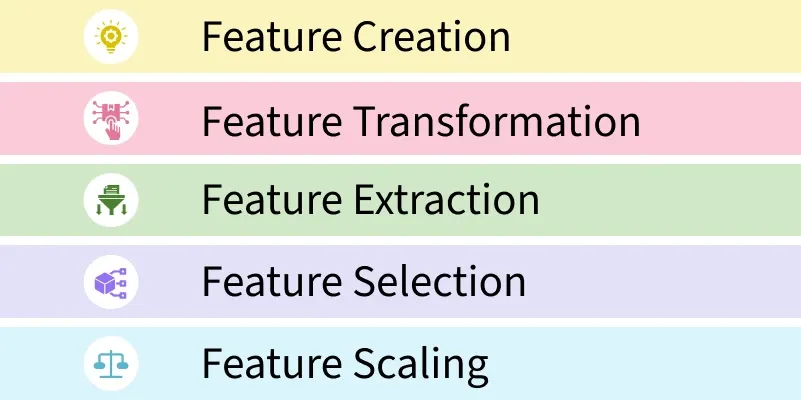
3. Scaling: Leveling the Playing Field
Imagine a dataset where “Age” goes from 0 to 100, but “Annual Income” goes from 0 to 1,000,000. Without scaling, the algorithm might think the income is 10,000 times more important than the age just because the numbers are bigger. We use normalization or standardization to make sure every feature has a fair voice.
Reality Check: The “Auto-ML” Myth
A common misconception today is that with the rise of Automated Machine Learning (AutoML), feature engineering is becoming obsolete.
Reality Check: While AutoML can handle basic tasks like scaling and simple encoding, it lacks “Domain Knowledge.” An automated tool doesn’t know that a specific public holiday in Indonesia affects shopping behavior differently than a holiday in New York. It doesn’t know the “why” behind the data. Until AI can understand human culture and physical reality, the most impactful features will still be designed by people.
The Rare Art: Feature Creation
This is the part of feature engineering that separates the juniors from the seniors. It’s not just about cleaning data; it’s about creating something that wasn’t there before.
-
Polynomial Features: Sometimes the relationship between two variables isn’t a straight line. By squaring or multiplying features together, you can capture complex interactions.
-
Time-Series Deconstruction: Taking a timestamp and breaking it down into “Hour of Day,” “Day of Week,” or even “Is It Payday?” can reveal cycles the model would otherwise miss.
-
Binning: Sometimes, the exact number doesn’t matter as much as the group it belongs to. Turning “Years of Experience” into “Junior,” “Mid-Level,” and “Expert” can simplify the model’s job significantly.
Handling the “Curse of Dimensionality”
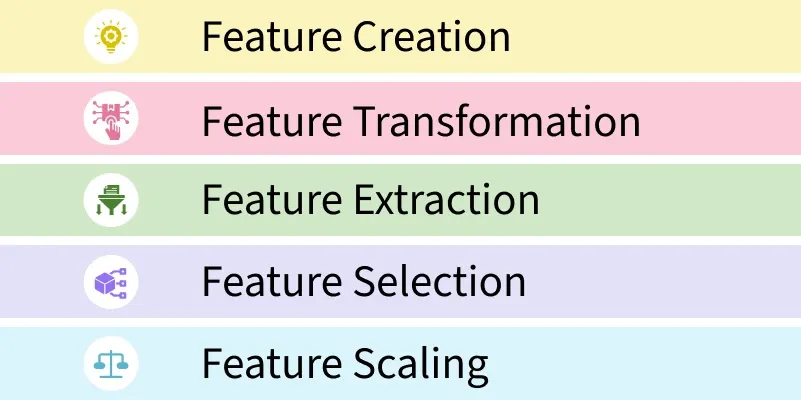
There is a catch. In our quest for perfect feature engineering, it’s easy to create too many features. This is known as the Curse of Dimensionality. The more features you have, the more data you need to prevent the model from just memorizing the noise (overfitting).
The secret is Feature Selection. You must be a ruthless editor. Use correlation matrices or “Feature Importance” scores to kill off the variables that aren’t pulling their weight. A lean model is a robust model.
Actionable Steps: How to Engineer Better Features Today
If you are working on a project right now, stop looking at your code for an hour and do this:
-
Talk to a Human Expert: If you’re building a medical AI, talk to a doctor. If it’s for finance, talk to an accountant. Ask them, “What one thing usually tells you a client is going to do X?” That “one thing” is your new feature.
-
Visualize the Outliers: Look at the data points that don’t fit. Why are they there? Often, an outlier is just a missing feature waiting to be discovered.
-
Iterate Fast: Don’t try to build the perfect feature set on day one. Build a simple model, see where it fails, and engineer a feature to fix that specific failure.
The Future: Deep Learning vs. Manual Engineering
In the age of Deep Learning, many argue that neural networks do their own feature engineering. While true for images and audio, for tabular data (the kind most businesses use), manual engineering is still the king. It provides transparency. When a model uses a feature you created, you can explain why it made a decision. In a world demanding “Explainable AI,” being a data sculptor is more important than ever.