Activation Function The Biological “Spark” Inside Your Neural Network
Without an activation function, the world’s most powerful supercomputer is essentially just a very expensive, oversized pocket calculator. You could stack a billion layers of neurons, feed them the most pristine data on earth, and use the fastest GPUs in existence, but the machine would still be incapable of recognizing a simple handwritten digit or predicting the stock market. It would be stuck in a “linear trap,” seeing the world as a straight line when, in reality, the world is a chaotic mess of curves and tangles.
In the simplest terms, an activation function is a mathematical gatekeeper. It sits at the output of each neuron and decides whether the information the neuron just processed is important enough to be passed on to the next layer. It is the “fire” or “don’t fire” signal that mimics how the neurons in your own brain operate.
The Linear Trap: Why We Need Non-Linearity
To understand the importance of this concept, we have to look at the math for a second (don’t worry, we’ll keep it painless). A neural network, at its core, performs a lot of multiplications and additions. This is “linear regression.” If you only use linear operations, no matter how many layers you add, the final result is still just a linear function.
It’s like trying to draw a circle using only a ruler. No matter how many short straight lines you draw, you’ll never get a perfect curve.
The activation function introduces “non-linearity.” This allows the network to learn complex patterns—the curves of a human face, the nuances of a foreign language, or the subtle anomalies in a heartbeat. Without this non-linear “spark,” deep learning isn’t actually “deep”; it’s just a glorified spreadsheet.
The Hall of Fame: Common Activation Functions

Not all gatekeepers are the same. Depending on what you’re trying to build, you might need a strict guard or a more relaxed one.
1. The Sigmoid: The Old Guard
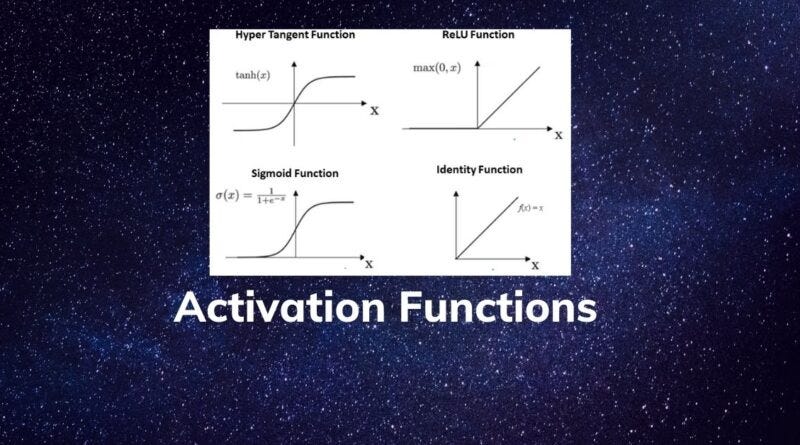
Sigmoid was the superstar of early AI. It takes any input and squashes it into a neat range between 0 and 1. This makes it perfect for models where you need to predict a probability (e.g., “Is this email spam or not?”).
Editorial Opinion: While Sigmoid is a classic, it’s also a bit of a relic for modern deep layers. It suffers from the “Vanishing Gradient” problem—where the signal becomes so small during training that the network stops learning entirely. It’s like trying to hear a whisper in a thunderstorm; eventually, the message just gets lost.
2. ReLU (Rectified Linear Unit): The Modern Workhorse
If you look under the hood of 90% of modern AI, you’ll find ReLU. Its logic is brutally simple: “If the input is negative, ignore it (return zero). If it’s positive, pass it through exactly as it is.”
Why does this work? Because it’s computationally cheap. It doesn’t require complex exponential math, allowing models to train incredibly fast. It effectively “turns off” neurons that aren’t contributing, creating a sparse and efficient network.
3. Tanh (Hyperbolic Tangent): The Balanced Middle
Tanh is like Sigmoid’s more energetic cousin. It squashes values between -1 and 1. Because its output is zero-centered, it often makes the learning process for the next layer a bit easier and faster.
Choosing the Right Function: A Practical Approach
You might be wondering, “Which one should I use?” While there is no “one-size-fits-all” answer, there are industry standards that most practitioners follow:
-
For Hidden Layers: Use ReLU by default. If you notice your neurons are “dying” (always outputting zero), try a variant like Leaky ReLU.
-
For Output Layers (Binary Classification): Use Sigmoid. You want a clear 0 to 1 probability.
-
For Output Layers (Multiple Categories): Use Softmax. It’s like Sigmoid but scaled across multiple possible answers so they all add up to 100%.
Reality Check: Activation Functions Don’t “Think”

A common misconception among beginners is that the activation function is where the “thinking” happens. It’s not. The thinking (or learning) happens in the weights—the connections between neurons. The activation function is simply the filter. Think of the weights as the intensity of the light and the activation function as the lens. The lens doesn’t create the light; it just shapes it so we can see an image clearly.
The “Vanishing Gradient” Nightmare
One of the most discussed (and feared) topics in deep learning is the Vanishing Gradient. When we train an AI, we calculate how much to change the weights by looking at the derivative of the activation function.
In functions like Sigmoid, the slope (derivative) becomes very flat at the ends. When you multiply many small slopes together across dozens of layers, the number shrinks to almost zero. The “gradient” vanishes, and the model becomes “stuck.” This is exactly why ReLU became the king of the industry—it has a constant slope for all positive values, keeping the “gradient” alive and kicking.
The Future: Adaptive Activation Functions
We are now seeing research into “Learnable” activation functions. Instead of a human picking “ReLU” or “Tanh,” the AI itself learns the best shape of the function during training. This is the next step in automation: machines that don’t just learn the data, but learn how they should perceive the data.
Conclusion: Turning Math into Meaning
The activation function is the bridge between raw data and actionable intelligence. It is the component that allows a machine to handle the messy, non-linear reality of our world. Whether it’s the simplicity of a ReLU or the probabilistic elegance of a Softmax, these functions are the silent heroes that make deep learning possible.
The next time you see an AI generate a stunning image or translate a complex sentence, remember that somewhere in that silicon brain, billions of activation functions were deciding which signals were worth keeping and which were just noise.