The Compass of Failure Why the Loss Function is the Secret Soul of AI
The most sophisticated AI in the world is, at its heart, a chronic perfectionist with a terrible sense of direction. It doesn’t know what “good” looks like; it only knows how much it currently hurts to be wrong. In the world of machine learning, we don’t teach computers to be right. We teach them to minimize their mistakes.
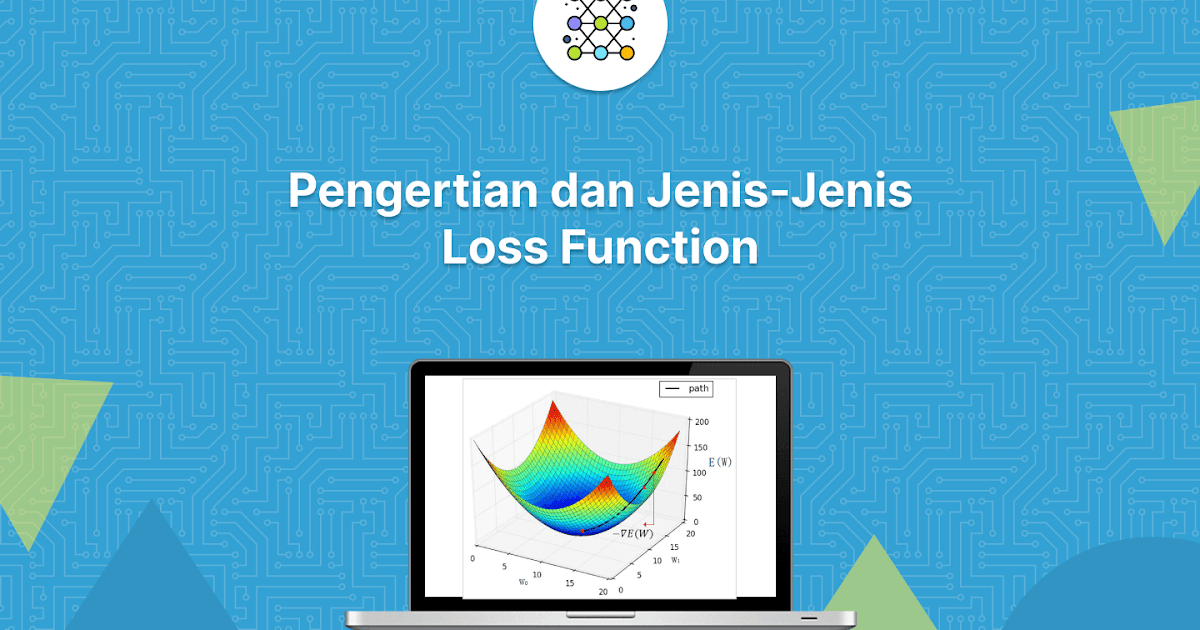
The loss function is the mathematical yardstick used to measure that mistake. If you think of an AI model as a traveler trying to find the bottom of a dark valley (a process called optimization), the loss function is the compass that tells the traveler exactly how many miles they are from the destination. Without it, the machine is just a pile of random numbers shouting into the void.
Understanding the Core: What is a Loss Function?
In simple terms, a loss function is a method of evaluating how well your specific algorithm models the given data. If the model’s predictions are way off, the loss function will output a high number. If the predictions are spot on, it outputs a low number.
The goal of every machine learning engineer is to get that number as close to zero as possible. But here is the catch: how you measure “distance” from the truth changes everything. Are you worried about being slightly off on every prediction, or are you terrified of being massively off on just one? Your choice of loss function determines the “personality” of your AI.
The Two Worlds: Regression vs. Classification

We generally split these mathematical compasses into two main camps based on what the AI is trying to do.
1. Regression: Measuring the Gap
When your AI is predicting a continuous number—like the price of a house or the temperature tomorrow—you need a regression loss function.
-
Mean Squared Error (MSE): This is the “strict teacher.” It squares the error, meaning it penalizes large mistakes much more heavily than small ones. It’s great for stability but can be easily distracted by “outliers” (data points that don’t fit the norm).
-
Mean Absolute Error (MAE): This is the “forgiving teacher.” It treats all errors linearly. It’s more robust if your data is messy and full of weird anomalies.
2. Classification: The Probability Game
When your AI is trying to put things into buckets (Is this a cat or a dog?), the math changes.
-
Binary Cross-Entropy: This is the gold standard for “Yes/No” questions. It measures the distance between the predicted probability and the actual label.
-
Categorical Cross-Entropy: Used when you have multiple labels (e.g., classifying 10 different types of fruit).
The Editorial Opinion: Math is a Mirror of Intent
Here’s something rarely discussed in generic tutorials: Choosing a loss function is an editorial decision, not just a technical one. If you use MSE for a medical diagnostic tool, you are telling the AI that one massive mistake is significantly worse than ten tiny ones. In medicine, that might save a life. However, if you use that same logic for a movie recommendation engine, your AI might become too “scared” to suggest anything experimental, sticking only to boring, safe blockbusters.
We must stop viewing these functions as static tools and start seeing them as the “values” we instill in our digital creations.
The Common Misconception: Loss vs. Metric
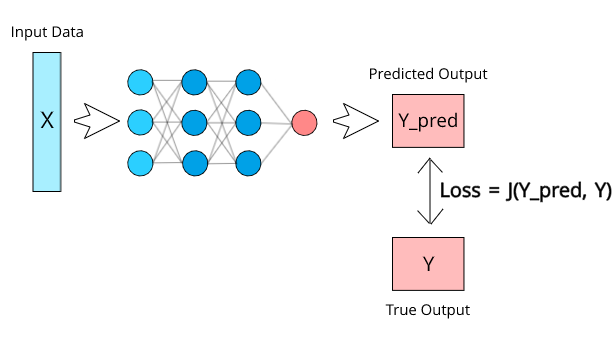
Reality Check: Many developers use the terms “loss function” and “metric” interchangeably. They are not the same.
-
Loss is used by the machine to learn during training. It must be “differentiable” so the math can flow backward (Backpropagation).
-
Metrics (like Accuracy or F1 Score) are used by humans to judge the model.
The machine doesn’t care about your “90% Accuracy” metric during training; it only cares about the gradient of the loss. If your loss function doesn’t align with your human metric, you’ll end up with a model that performs great in the lab but fails in the real world.
Practical Action: How to Choose Your Compass
How do you practically decide which loss function to use? Don’t just stick to the defaults in your library. Follow this mental checklist:
-
Check your Outliers: If your data is “noisy,” avoid Mean Squared Error. Use Huber Loss, which acts like MSE for small errors but switches to MAE for large ones—it’s the best of both worlds.
-
Define the Cost of Being Wrong: In your specific use case, is a big mistake catastrophic or just annoying?
-
Balance your Classes: If you are detecting rare diseases where 99% of people are healthy, a standard cross-entropy loss will fail. You’ll need a “Weighted” loss function to tell the AI that finding the 1% is more important than being right about the 99%.
The Future of Learning: Beyond the Standard Formulas
We are entering an era of “Custom Loss Functions.” In fields like Generative Adversarial Networks (GANs)—the tech behind AI-generated art—the loss function is actually another AI model (the Discriminator) that learns how to critique the first model.
This meta-layer of loss is where the future of AI lies. We are moving away from fixed formulas like $y – \hat{y}$ and moving toward systems that learn the nuance of “wrongness” in the same way a human art critic learns to spot a fake painting.
Final Thoughts: Embracing the Error
At the end of the day, a loss function isn’t about the math; it’s about the mission. It is the bridge between a human’s goal and a machine’s execution. By understanding how we measure failure, we get one step closer to defining what it means for a machine to truly succeed.