Cross Validation: Why Your AI Model Needs a Reality Check
Have you ever met someone who is “book smart” but completely useless in a real-world crisis? They can recite every line from a textbook, yet they freeze when faced with a problem that wasn’t in the chapter. In the world of machine learning, we call this person an “overfitted model.”
A computer is a world-class memorizer. If you give it a dataset, it will try its best to memorize every quirk, every noise, and every outlier just to get a 100% score on its test. But the moment it leaves the lab and faces real, messy human data, it collapses. Cross validation is the rigorous training regimen we use to make sure our digital students are actually learning the “why” and not just the “what.”
The Heart of the Matter: Beyond the Train-Test Split
In the early days of data science, we simply split data into two piles: 80% for training and 20% for testing. It’s a clean approach, but it’s dangerous. What if that 20% “test” pile just happens to be the easiest data points? Or the hardest?
Cross validation solves this by being relentlessly fair. Instead of one fixed test, it rotates the data. It’s like a teacher who doesn’t just give one final exam, but ten different quizzes throughout the semester, swapping the questions every time. By the end, you don’t just know if the student passed; you know if they understand.
Editorial Opinion: Many developers treat validation as a final “check-the-box” step. I argue it’s the most creative part of the pipeline. It’s where you act as the devil’s advocate for your own creation, trying to find the holes in its logic before the world does.
The Reality Check: Validation Isn’t a Cure for Bad Data
There is a dangerous misconception that cross validation can “fix” a bad model. Reality check: If your original data is biased, or if you’ve “leaked” information from the future into your training set, cross validation will happily give you a high score that means absolutely nothing. It is a diagnostic tool, not a magic wand. It can tell you that your model is broken, but it won’t tell you how to be a better data scientist.
The Gold Standard: K-Fold Cross Validation
When people talk about this topic, they are usually referring to K-Fold. Here is how it works in plain English:
-
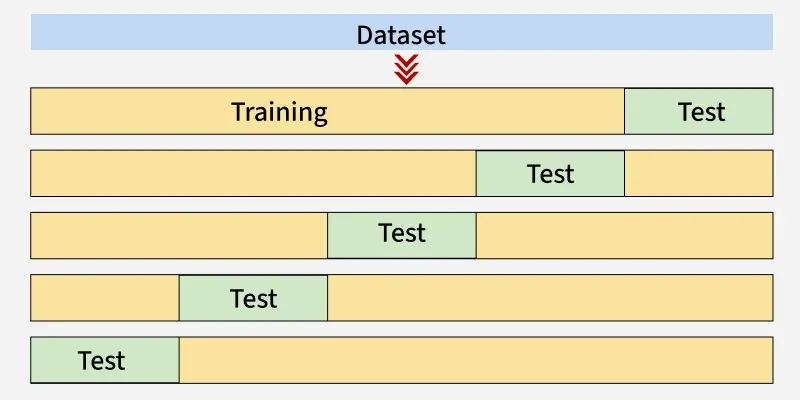
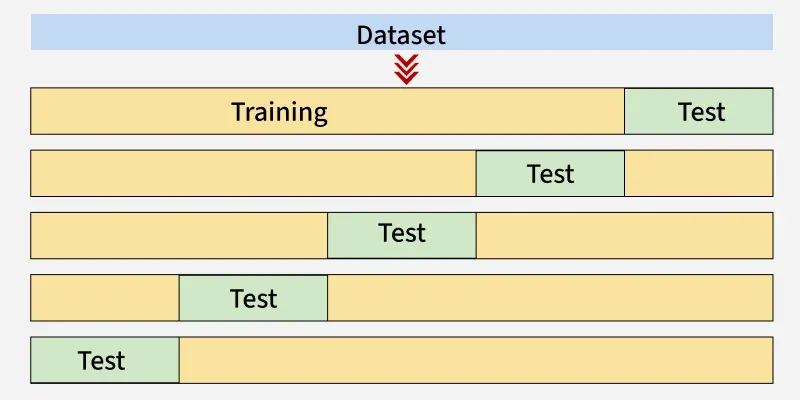
You take your data and chop it into k equal pieces (usually 5 or 10).
-
You train the model on k-1 pieces and test it on the remaining one.
-
You repeat this process k times, so every piece of data gets a turn to be the “test set.”
-
You average the results.
This average is the truth. It’s much harder to “fake” a high score across ten different rotations than it is on one lucky split.
Variations You Should Know: Leave-One-Out and Stratified
Not every dataset is the same, so not every validation should be the same.
-
Stratified K-Fold: Imagine you’re building a model to detect a rare disease that only 1% of people have. If you split your data randomly, your test set might have zero cases of the disease. Stratified sampling ensures that each “fold” has the same percentage of the rare class as the original data.
-
Leave-One-Out (LOOCV): This is the extreme version. If you have 100 data points, you train on 99 and test on 1. You do this 100 times. It’s computationally expensive but brilliant for small datasets where every single row is precious.
The “Hidden” Enemy: Data Leakage
A topic that rarely gets enough airtime in basic tutorials is Data Leakage during cross validation. This happens when you perform your data preprocessing (like scaling or normalizing) before you split the folds.
If you calculate the average of the whole dataset and use it to scale your training fold, you’ve essentially “peeked” at the test data. Your cross validation scores will look amazing, but your real-world performance will be mediocre. The rule of thumb? Always build your “pipeline” inside the cross validation loop.
Practical Action: How to Implement Better Validation

If you’re sitting in front of a Python script right now, do these three things:
-
Stop using
train_test_splitfor small data. Usecross_val_scorefrom Scikit-Learn instead. It gives you a much better sense of the “variance” in your model’s performance. -
Look at the standard deviation. If your model gets 90% accuracy in one fold and 60% in another, your model is unstable. A “good” model should perform consistently across all folds.
-
Use Time-Series Split for temporal data. If your data is time-dependent (like stock prices), a random K-Fold will fail because you’ll be using future data to predict the past. Use a specialized “rolling” window for validation.
Conclusion: Respect the Process
In the rush to build the “next big thing” in AI, it’s easy to skip the boring stuff like validation. But cross validation is what separates the professionals from the hobbyists. It’s the difference between a model that looks good in a PowerPoint presentation and a model that actually works when the stakes are high.
Build your model, but then—immediately and ruthlessly—try to prove it wrong. That is the essence of true machine learning.