The Ghostwriter in the Machine: Mastering the Modern AI Writing Tool
There is a specific kind of anxiety that strikes when you stare at a blinking cursor on a white screen—the psychological weight of a thousand unwritten words.
For decades, writers fought this battle with caffeine and sheer willpower. Today, we fight it with a prompt. The rise of the ai writing tool has fundamentally changed our relationship with the alphabet. We’ve moved from being “creators from scratch” to “curators of probability.” But as the internet becomes flooded with beige, repetitive content, the real skill isn’t knowing how to generate text; it’s knowing how to steer the machine so it doesn’t drive your brand into a ditch of mediocrity.
The Architecture of Assistance: How These Tools Actually Work
To use an ai writing tool effectively, you have to stop thinking of it as a magic wand and start seeing it as a Large Language Model (LLM) built on statistical likelihood.
When you ask an AI to write a blog post, it isn’t “thinking.” It is predicting the next most logical word based on billions of pages of human history. Most modern tools are built on architectures like GPT-4 or Claude, which excel at:
-
Structural Scaffolding: Turning a messy brain dump into a coherent H2/H3 outline.
-
Tone Shifting: Taking a dry technical manual and rewriting it to sound like a friendly neighbor.
-
Expansion and Compression: Taking a single sentence and blooming it into a paragraph, or vice versa.
Editorial Opinion: The biggest mistake people make is using AI to do the thinking for them. AI should handle the construction, but the intent must be 100% human. If you let the bot decide your argument, you’ve already lost your competitive edge.
Reality Check: The “One-Click Article” Delusion

There is a massive misconception that you can click a button and get a “ready-to-publish” 1500-word article. This is a lie.
An ai writing tool can produce a draft in seconds, but that draft is often filled with “hallucinations” (fake facts), repetitive sentence structures, and a total lack of original insight. If you publish raw AI output, you aren’t a writer; you’re a spammer. A high-quality AI-assisted piece requires a “Human-in-the-loop” process—fact-checking, injecting personal anecdotes, and cutting the “fluff” that AI loves to generate.
Why Your AI Content Sounds Like a Robot (And How to Fix It)
If you’ve noticed that every AI-generated intro starts with “In the fast-paced digital world…” you’ve seen the “AI accent.” To break this, you need to go beyond the basic prompt.
-
The “Uncommon Constraint” Technique: Tell the ai writing tool what not to do. (e.g., “Write about SEO but do not use the words ‘game-changer,’ ‘delve,’ or ‘leverage’.”)
-
The Anecdote Injection: AI cannot remember a time it felt embarrassed, proud, or heartbroken. You must manually add these “human spikes.”
-
Vary the Sentence Length: AI tends to write mid-length, rhythmic sentences. Go in and add some short, punchy ones. Like this.
Practical Action: A Workflow for the 2026 Writer
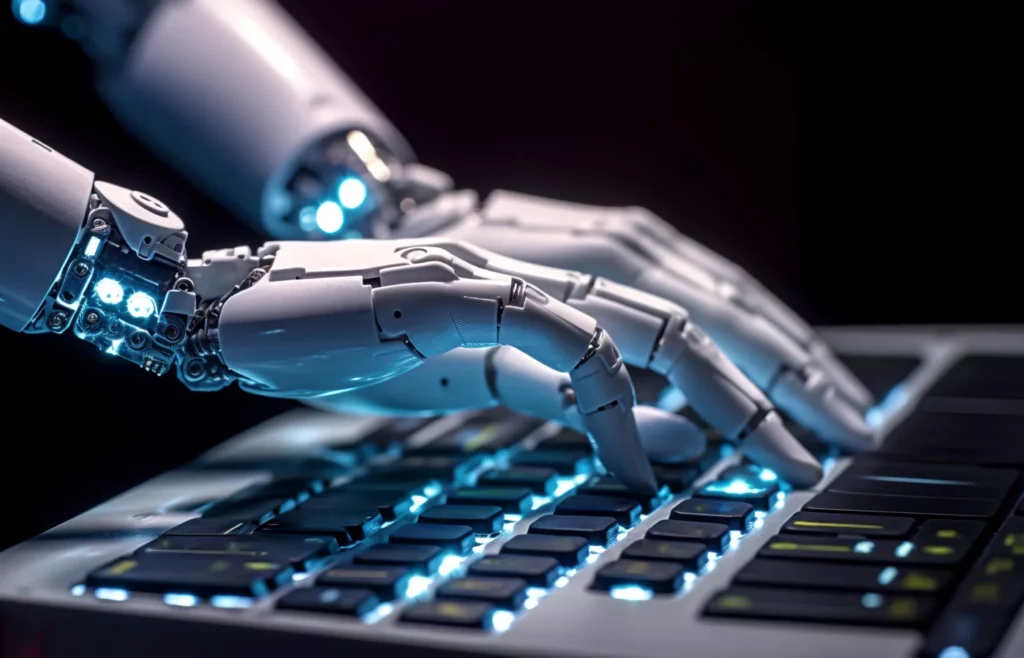
Don’t just ask the AI to “write an article.” Use this modular approach to get the most out of your ai writing tool:
-
Ideation Phase: Ask the AI for 20 “unconventional” angles on your topic. Pick the weirdest one.
-
Outline Phase: Provide your key points and ask the AI to organize them for maximum SEO impact.
-
Drafting Phase: Generate the draft section by section, not all at once. This keeps the AI focused.
-
The “Vibe Check” Edit: Read the draft out loud. If a sentence sounds like something a corporate brochure would say, delete it.
The Ethical and SEO Horizon
Google’s stance has evolved: they don’t punish AI content; they punish low-effort content. Whether a human or an ai writing tool wrote it, if it provides zero value to the reader, it will sink.
Moreover, we are entering the era of “AI-Proofing” our careers. As tools become more capable of mimicry, the value of lived experience and unique opinion skyrockets. The future of writing isn’t about competing with the machine—it’s about using the machine to clear the mundane tasks so you have the energy to be more human than ever.