The Art of Admitting Failure How Backpropagation Trains AI
Most humans spend their entire lives trying to hide their mistakes, but an artificial neural network does the exact opposite: it obsessively calculates its failures to become better. This psychological pivot—treating an error not as a defeat but as a precise instruction for improvement—is what makes modern AI possible.
At the heart of this process is backpropagation. It is the fundamental mechanism that allows a machine to realize it was wrong, trace that wrongness back to the source, and adjust its internal settings so it doesn’t make the same mistake twice. If a neural network is the “brain” of AI, then backpropagation is the conscience that whispers, “You missed the mark; here is exactly how to fix it.”
The Blame Game: How Machines “Learn”
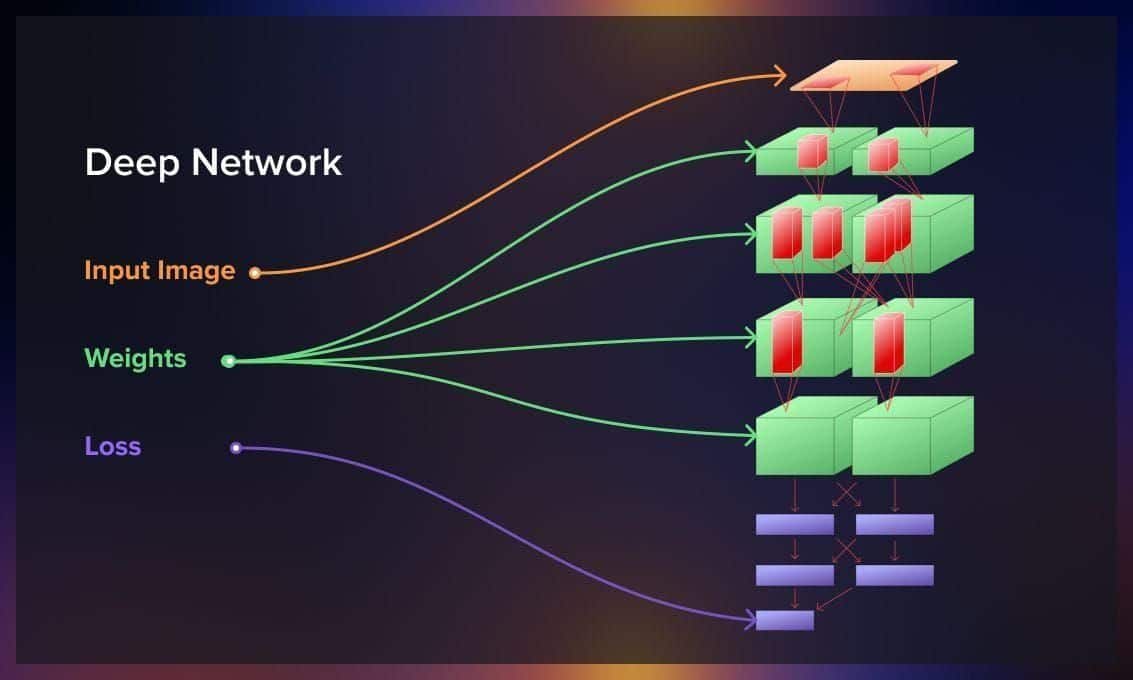
To understand backpropagation, you first have to understand the “Forward Pass.” When you show an AI a picture of a dog and it guesses “Toaster,” that is the forward pass. The data traveled from the input, through layers of digital neurons, and spat out a wildly incorrect answer at the end.
This is where the magic happens. The system calculates the “Loss”—the distance between its guess (Toaster) and the truth (Dog). Backpropagation is the return journey. It travels backward from the error, distributing the “blame” to every single neuron involved in that guess.
The Chain Rule of Responsibility

In technical terms, this uses the “Chain Rule” from calculus, but in a human sense, it’s just accountability. The algorithm looks at the final layer and says, “You were 90% wrong.” Then it moves to the layer before that and says, “And you contributed this much to that 90%.” It continues until it reaches the very beginning, adjusting the “weights” (the importance of certain signals) along the way.
Reality Check: It’s Not “Thinking,” It’s Optimization
A common misconception is that during backpropagation, the AI is “understanding” the concept of a dog.
The Reality: The AI has no idea what a dog is. It just knows that if it changes a specific numerical weight from 0.5 to 0.48, the “error score” goes down. It is an exercise in multi-dimensional curve fitting. It’s more like a blind hiker trying to find the lowest point in a valley by feeling the slope of the ground with their feet. They don’t need to see the valley to find the bottom; they just need to know which way is “down.”
Why This is the Heartbeat of Modern Tech
Without backpropagation, we wouldn’t have ChatGPT, self-driving cars, or medical AI that detects tumors. Here is why this specific process is the editorial hero of the AI revolution:
1. Efficiency Over Brutality
In the early days of AI, researchers tried to change weights randomly to see what worked. It was like trying to crack a safe by spinning the dial blindly. Backpropagation provides the “gradient”—the direction of the win. It tells the safe-cracker exactly which way to turn the dial and by how many degrees.
2. Deep Learning Scalability
As neural networks get deeper (more layers), it becomes impossible for a human to tune them. Backpropagation automates this “tuning” across billions of parameters. It allows the system to self-organize.
The Editorial Take: The Obsession with “Loss”
In my opinion, we focus too much on the “intelligence” of AI and not enough on the “Loss Function.” The backpropagation process is only as good as the way we define failure.
If you tell an AI to minimize “Loss” in a way that prioritizes engagement over truth (like social media algorithms often do), backpropagation will perfect that mission with ruthless efficiency. The machine isn’t being “evil”; it’s just being incredibly good at correcting its path toward a poorly defined goal. This is the “alignment problem” in a nutshell: the math is perfect, but the objectives are often flawed.
Practical Insights for Developers and Enthusiasts
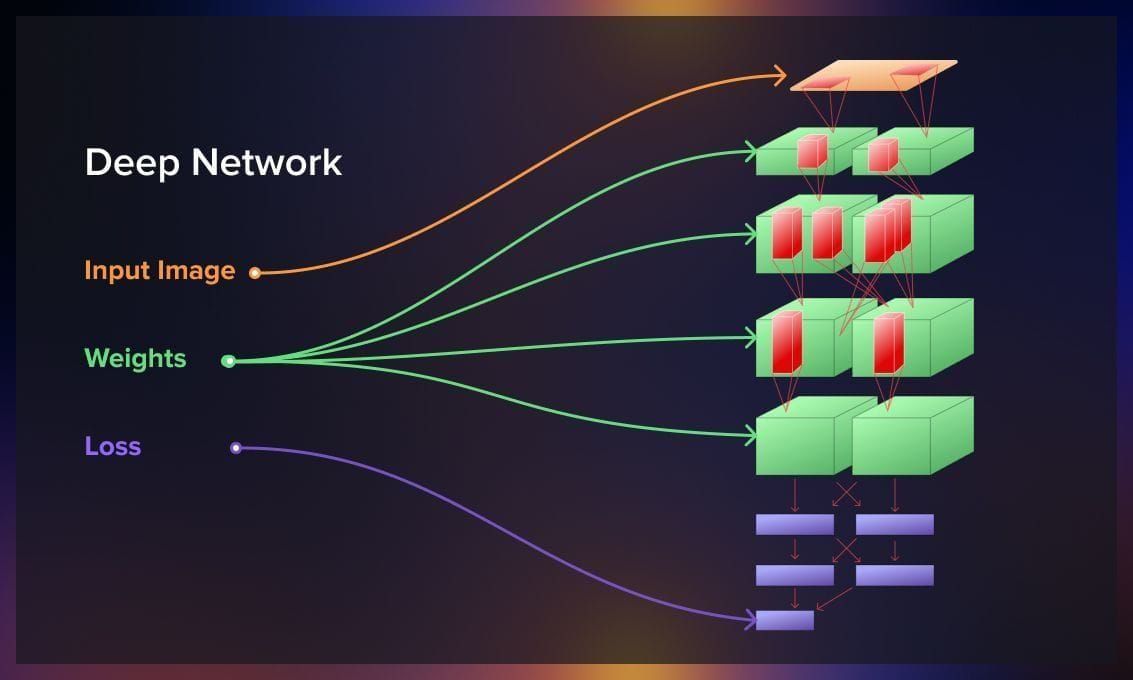
If you are looking to master backpropagation, don’t just memorize the partial derivatives. Focus on these three practical pillars:
-
Vanishing Gradients: Sometimes, in very deep networks, the “blame” gets smaller and smaller as it travels back until it disappears (zeros out). This means the early layers never learn. Using different activation functions like ReLU (Rectified Linear Unit) is the practical fix for this.
-
Learning Rate Matters: If your learning rate is too high, the AI “over-corrects” and bounces around the valley like a pinball. If it’s too low, it takes forever to learn. Finding the “Goldilocks” rate is the secret sauce of a good engineer.
-
The Power of Batching: You don’t backpropagate after every single image. You do it in “batches.” It’s like a student studying 32 flashcards before checking the answer key to see how they did overall. It stabilizes the learning process.
The Rare Perspective: The Biological Difference
We often compare backpropagation to the human brain, but here is something rarely discussed: The human brain probably doesn’t use backpropagation.
Biology is messy. Neurons don’t send detailed mathematical error signals backward in perfectly synchronized waves. Our brains learn through “local” updates. This is why AI is currently much more energy-hungry than a human brain. We are using a mathematically “perfect” but biologically “unnatural” method to force machines to learn. The next big leap in AI might involve finding a way to learn that doesn’t require the heavy lifting of backpropagation.
Summary: Failure is the Fuel
At the end of the day, backpropagation is a reminder that intelligence is built on a foundation of corrected errors. It is the bridge between a machine that guesses and a machine that knows. By quantifying failure, we’ve created a system that can simulate a version of wisdom—one weight adjustment at a time.