Gradient Descent The Mathematical Compass Guiding Every AI
Imagine you are standing at the peak of a jagged mountain range. Suddenly, a thick, impenetrable fog rolls in. You can’t see more than two inches in front of your face, and your goal is to reach the lowest valley where your base camp is located. You have no map, no GPS, and no sight.
What do you do? You use your feet. You feel the slope of the ground. If the ground tilts upward to the left, you step to the right. If it dips sharply in front of you, you take a cautious step forward. By constantly feeling the “gradient” of the slope under your boots and moving in the direction that goes down, you eventually—step by agonizing step—reach the bottom.
In the silicon world, this is exactly how gradient descent works. It is the fundamental optimization algorithm that allows Artificial Intelligence to stop guessing and start learning.
The Engine of Optimization
Every time an AI model makes a mistake, it needs a way to fix it. If a neural network predicts a house price and is off by $100,000, it can’t just throw a tantrum. It needs to adjust its internal “knobs” (which we call weights and biases) to reduce that error.
Gradient descent is the mathematical tool that tells the model exactly which way to turn those knobs. It calculates the “slope” of the error—the gradient—and moves the model’s parameters in the opposite direction. If the error is high, the gradient is steep. As the error decreases, the slope flattens out, telling the AI it is getting closer to the “valley” of perfect accuracy.
Editorial Opinion: We often romanticize AI as this mysterious, ethereal force. In reality, it is remarkably humble. AI doesn’t “know” the right answer; it is simply an algorithm that is terrified of being wrong and spends its entire life trying to be slightly less wrong than it was a millisecond ago.
The Reality Check: It’s Not a Straight Line to Success
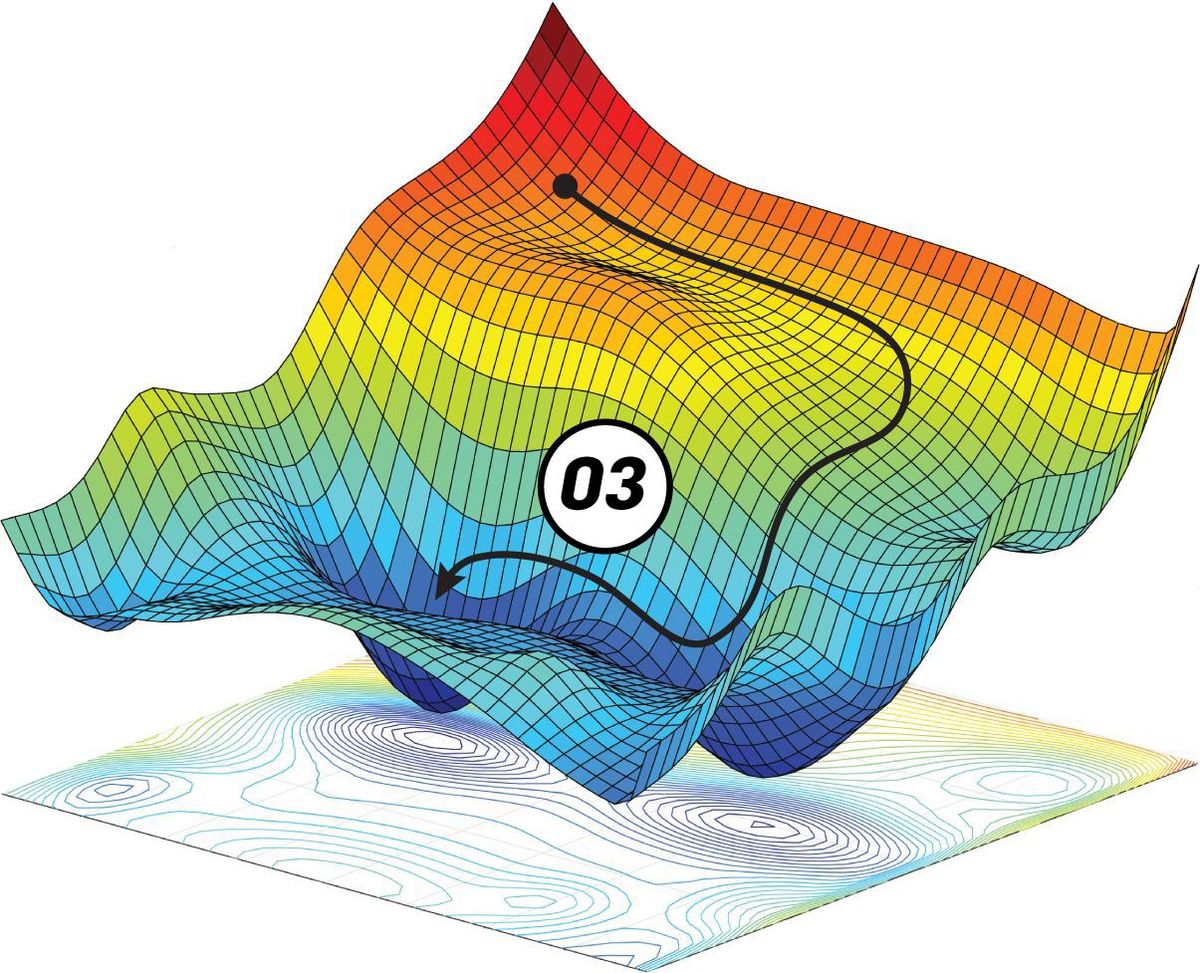
There is a massive misconception that gradient descent is a smooth, elegant slide to the bottom of a hill. Reality check: The “loss landscape” (the mathematical mountain range) is rarely a perfect bowl. It is usually full of “Local Minima”—tiny potholes that feel like the bottom but aren’t the actual valley. An AI can get stuck in one of these potholes, thinking it has found the best solution when, in fact, there’s a much deeper valley just over the next ridge. This is why AI training often requires “shaking” the model (momentum) to jump out of these traps.
The Crucial Role of the “Learning Rate”
If gradient descent is the compass, the Learning Rate is the size of your stride. This is the most important setting you’ll ever tweak in a model:
-
The Giant Leap: If your learning rate is too high, you’re taking massive jumps. You might overstep the valley entirely and end up on a higher peak on the other side. This is called “overshooting,” and it causes the model to diverge and fail.
-
The Baby Step: If your learning rate is too low, you’re moving an inch at a time. The model will eventually reach the bottom, but it might take years of computing power (and a very expensive electricity bill) to get there.
Finding the “Goldilocks” learning rate—not too big, not too small—is where the science of AI meets the art of engineering.
Three Flavors of Descent: Batch, Stochastic, and Mini-Batch
Not all descents are created equal. Depending on the size of your data, you choose your “walking style”:
-
Batch Gradient Descent: The perfectionist. It looks at every single piece of data you have before taking one step. It’s accurate but painfully slow on large datasets.
-
Stochastic Gradient Descent (SGD): The chaotic runner. It looks at just one random data point, takes a step, and repeats. It’s incredibly fast but zig-zags wildly.
-
Mini-Batch Gradient Descent: The balanced athlete. It looks at a small group (a “batch”) of data points. This is the industry standard—fast enough to be efficient, stable enough to be reliable.
Common Pitfalls: Vanishing and Exploding Gradients

In very deep neural networks, the gradient can sometimes become so tiny that it basically disappears (Vanishing Gradient). The AI stops learning because it can no longer “feel” the slope of the mountain. Conversely, the gradient can become so massive that it “explodes,” sending the model’s math into a chaotic spiral. Modern techniques like Batch Normalization and specific Activation Functions (like ReLU) are the safety harnesses we use to keep the AI from falling off these mathematical cliffs.
Practical Action: How to Visualize Your Optimization
If you are building a model, don’t just look at the final accuracy percentage. Watch the Loss Curve.
-
If the curve is bouncing up and down like a heart rate monitor, your learning rate is likely too high.
-
If the curve is a flat line that never moves, you’re stuck in a local minimum or your learning rate is too low.
-
A healthy curve should look like a gentle slide down into a calm pool of water.
Conclusion: The Beauty of the Downward Step
Gradient descent teaches us that perfection isn’t found in a single leap of genius. It is found in the relentless, calculated reduction of error. By embracing the gradient—the signal within the noise of our mistakes—we have built machines that can recognize faces, translate languages, and predict the future. We didn’t give them a map; we just taught them how to feel the slope and keep walking down.