The Art of Digital Literacy How Named Entity Recognition Makes Sense of Our Messy Data
If I told you that “Apple is falling,” would you look at the stock market or run for a fruit basket? To a human, the answer is usually obvious based on whether you’re reading The Wall Street Journal or a cookbook. To a computer, however, language is just a chaotic soup of strings and characters. Without a way to distinguish a trillion-dollar tech giant from a piece of fruit, AI is effectively illiterate.
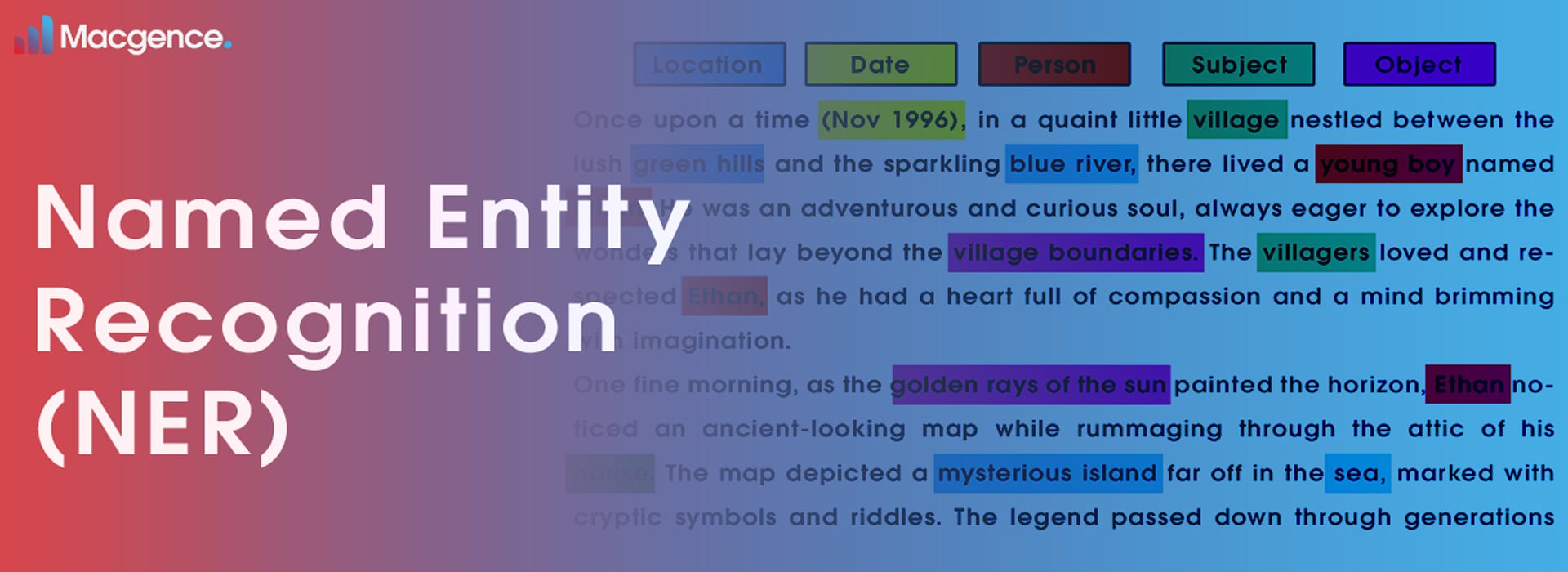
This is where Named Entity Recognition (NER) steps in. It is the sophisticated “detective” of the AI world, a sub-task of Natural Language Processing (NLP) that identifies and categorizes key information in text—turning “Apple” into an Organization and “Tim Cook” into a Person. It is the bridge between human nuance and machine logic, ensuring that information isn’t just processed, but understood.
The Anatomy of an Entity: How NER Actually Works
At its simplest level, NER is about spotting proper nouns and giving them a job title. But modern named entity recognition is far more than a glorified dictionary. It functions through a three-step cognitive dance that allows machines to parse through billions of words per second.
Detection and Classification

First, the system scans the text to identify “entities.” These are the boundary points where a specific concept begins and ends. Once an entity like “Paris” is spotted, the system must classify it. Is it a Location (the capital of France), a Person (Paris Hilton), or perhaps even a mythological figure from the Trojan War?
The Evolution of the Brain
In the early days, NER relied on “Rule-Based” systems—essentially a massive list of “if-then” statements created by linguists. Today, we use deep learning and Transformer models (like BERT or GPT). these models don’t just look at the word; they look at the neighbors. If the word “CEO” appears three words before a name, the probability that the entity is a “Person” skyrockets. This contextual awareness is what separates basic search from true intelligence.
Reality Check: NER is Not a “Fact-Checker”
A common misconception is that if an AI labels something via named entity recognition, it means the information is true. This is a dangerous assumption. NER is designed to identify categories, not verify facts.
If a news article says, “Elon Musk moved to Mars in 1920,” a high-quality NER system will correctly identify “Elon Musk” as a Person and “Mars” as a Location. It has done its job perfectly. However, the statement itself is historically and physically impossible. Users often mistake the structural precision of AI for intellectual honesty. NER helps us organize data, but it doesn’t possess the “wisdom” to know when that data is nonsense.
Why NER is the Silent Engine of Modern Business
While things like ChatGPT get all the headlines, NER is the silent workhorse running in the background of almost every digital interaction you have.
Transforming Customer Support
Imagine a company receiving 50,000 emails a day. Humans can’t read them all fast enough. NER systems automatically scan these emails, extracting names, order numbers, and specific product mentions. This allows the system to route a “Missing MacBook” complaint directly to the hardware department without a human ever touching the “Inbox” button.
High-Frequency Finance
In the world of trading, seconds are worth millions. Hedge funds use NER to scan thousands of news headlines per minute. If a system detects “Merger,” “Acquisition,” and “Microsoft” in the same sentence, it can trigger a trade faster than a human could even finish reading the headline.
Healthcare and Patient Records
One of the most vital—yet rarely discussed—uses of NER is in clinical trials and medical history. Doctors often write messy, unstructured notes. Named Entity Recognition can pull out dosages, drug names, and symptoms from these notes, turning thousands of pages of PDF files into a structured database that can help identify patterns in disease outbreaks or drug side effects.
The Hidden Challenge: The “Ambiguity Trap”
The reason NER remains one of the hardest problems in AI is that human language is inherently slippery. Words shift meaning based on culture, slang, and time.
For example, take the word “Tesla.” Is it:
-
The Person: Nikola Tesla, the inventor?
-
The Company: The EV manufacturer?
-
The Unit: The SI unit of magnetic flux density?
Without robust named entity recognition that understands global context, a data analysis tool might conflate a physics paper with a stock report. This is why editorial oversight in training data is so crucial. If we train AI on biased or narrow datasets, the “entities” it recognizes will reflect those same blind spots, leading to flawed insights and automated errors.
Practical Steps: How to Leverage NER Today

If you are a developer, marketer, or business owner, you don’t need to build these models from scratch. The barrier to entry has never been lower.
-
Use Pre-trained Libraries: Tools like spaCy or NLTK offer “off-the-shelf” NER models that can identify standard entities (Names, Dates, Locations) with incredible accuracy.
-
Clean Your Data First: NER thrives on clean, well-punctuated text. Before running your data through a model, remove excessive HTML tags or “noise” that might confuse the entity boundaries.
-
Human-in-the-Loop: For high-stakes industries like law or medicine, never let the NER system have the final say. Use it to highlight and organize, but keep a human editor to verify the edge cases where language gets tricky.
The Future: From Identification to Relation
The next frontier of named entity recognition isn’t just identifying that “Person A” and “Company B” exist in a sentence. It’s about Relationship Extraction. It’s the ability for AI to understand that “Person A” works for “Company B” and lives in “City C.”
We are moving from a world where computers “see” words to a world where they understand the web of connections that define our reality. As our digital footprints grow, the ability to turn our messy, human stories into structured, actionable knowledge will be the most valuable currency we have.