The Memorization Trap Mastering Overfitting Prevention for Smarter AI
Imagine a student who memorizes every single practice exam for a month. On the day of the test, he scores a perfect 100%. However, when the professor changes just one word in a question, the student fails completely. He didn’t learn the concept; he simply memorized the ink on the page. In the world of data science, we call this a failure of overfitting prevention.
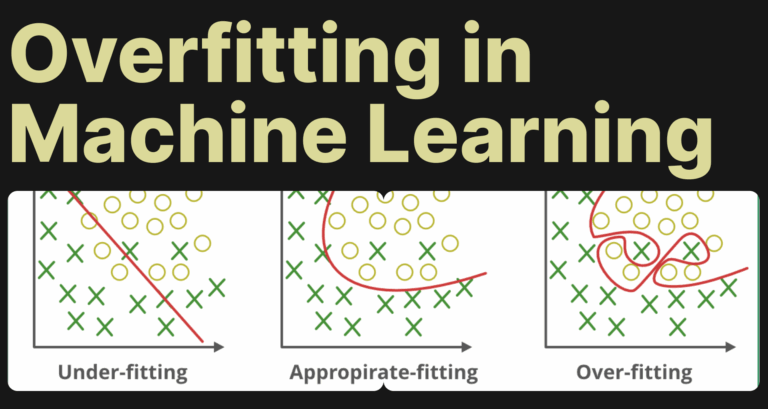
The goal of machine learning is generalization. We want a model that performs well on data it has never seen before. When a model fits its training data too closely, it begins to treat “noise” as “truth.” This makes it useless for real-world predictions.
Why Does Overfitting Happen?
Overfitting occurs when a model is too complex relative to the amount of data available. It starts “hallucinating” patterns that don’t actually exist.
Think of it like a detective who finds a red hair at three different crime scenes. Instead of looking for a killer, he starts arresting everyone with red hair. He is overfitting his theory to a small, coincidental detail. Effective overfitting prevention ensures the detective looks at the bigger picture.
The Reality Check: A common misconception is that a 99% accuracy rate on your training set is a good thing. It usually isn’t. High training accuracy paired with low validation accuracy is a major red flag. It means your model has stopped learning and started memorizing.
Key Strategies for Overfitting Prevention

To build a robust model, you need to force it to simplify. Here are the industry-standard techniques to keep your AI on track.
1. Cross-Validation: The Ultimate Stress Test
Don’t rely on just one split of your data. Use K-Fold Cross-Validation. This method rotates which part of the data is used for testing. It ensures the model can handle different versions of “the truth” before it goes live.
2. Regularization: The Digital Penalty
Regularization techniques, like L1 (Lasso) and L2 (Ridge), add a penalty to the model’s complexity. It discourages the model from relying too heavily on any single feature. It’s like telling the detective: “Don’t build your whole case on just one piece of evidence.”
3. Dropout: Keeping the Neurons Guessing
Common in deep learning, Dropout randomly “turns off” neurons during training. This prevents any one group of neurons from becoming too specialized. It forces the entire network to share the workload, making it more resilient and balanced.
The Editorial Perspective: The “Less is More” Philosophy
In our rush to build the “deepest” or “most complex” models, we often forget that simplicity is a feature. An over-engineered model is a fragile model.
True expertise isn’t in adding more layers. It’s in knowing exactly how many layers you can remove while still getting the job done. Good overfitting prevention is about finding the point of maximum utility with minimum complexity. It is about digital restraint.
Data Augmentation: Expanding the Worldview
Sometimes, the problem isn’t the model; it’s the lack of variety in the data. If your AI only sees photos of dogs during the day, it might think dogs don’t exist at night.
Data augmentation creates “new” data from your existing set. You can flip images, change colors, or add artificial noise. This teaches the model that the core object is what matters, not the background or the lighting.
Rare Insights: The Early Stopping Secret

One of the most effective tools is also the simplest: Early Stopping.
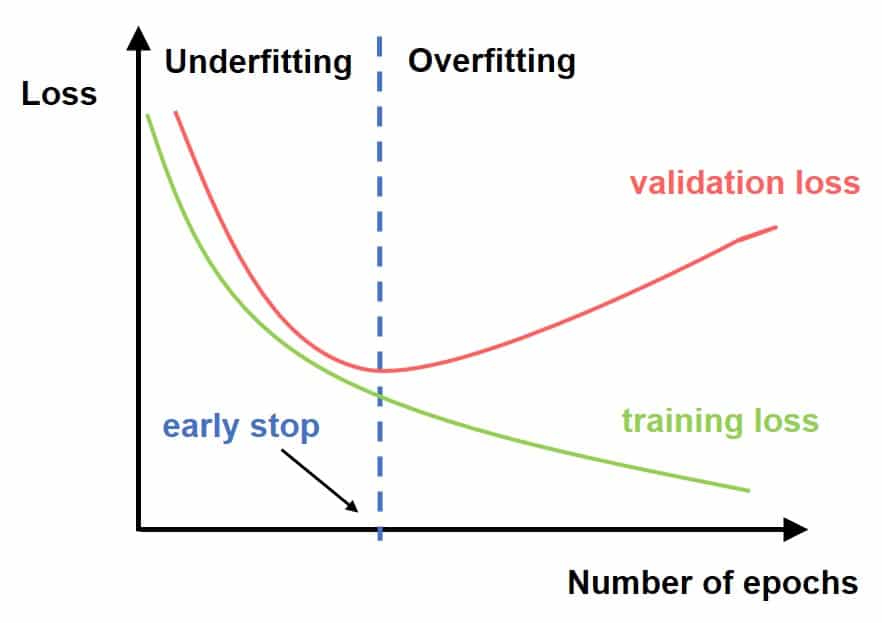
As a model trains, its performance on the validation set usually improves up to a certain point. After that, it starts to decline as overfitting kicks in. Early stopping tells the computer: “Stop training the moment the validation error starts to rise.” Don’t wait for the timer to end. Stop while the model is still thinking clearly.
Practical Steps to Protect Your Model
If you are currently building a model, take these actions to ensure stability:
-
Monitor Your Curves: Always plot your training vs. validation loss. If the lines start to diverge, you have an overfitting problem.
-
Simplify First: Start with a simple linear model. Only add complexity if the simple version can’t capture the basic trends.
-
Audit Your Features: Remove data points that are irrelevant. Extra “junk” data is just more fuel for overfitting.
-
Get More Data: It sounds obvious, but a larger dataset is the most natural form of overfitting prevention.
Conclusion: Building for the Real World
A model that works perfectly in a lab but fails in the street is a liability. By mastering overfitting prevention, you are moving from being a “code-runner” to a “system-builder.”
The goal of AI is to mimic human intuition—the ability to see the forest, not just the individual trees. Keep your models lean, test them hard, and never trust a perfect score that seems too good to be true.