The Day Machines Finally Learned to Read Between the Lines
Imagine you are reading the sentence: “The bank was closed because the river overflowed.” As a human, you don’t even blink. You know we aren’t talking about a financial institution. But for decades, computers were functionally illiterate in this regard. They read left-to-right, like a nervous student pointing at words one by one, completely missing the “river” at the end of the sentence until it was too late to reinterpret the “bank” at the beginning.
Then came the BERT language model.
Developed by Google, BERT (Bidirectional Encoder Representations from Transformers) didn’t just add more data to the pile; it changed the fundamental direction of machine thought. By looking at words in both directions simultaneously, it gave AI the ability to understand nuance, sarcasm, and intent—the very things that make human language so messy and beautiful.
What Makes BERT the “Quiet Revolution” of NLP?
In the current hype cycle of Chatbots that can write poetry and code, the BERT language model often feels like the sophisticated older sibling who doesn’t need to shout to be heard. While newer models focus on generating text, BERT’s superpower is understanding it.
The “B” in BERT stands for Bidirectional. This is its crown jewel. Unlike previous models that processed text sequences linearly (left-to-right or right-to-left), BERT uses a Transformer encoder to look at the entire sequence of words at once.
Editorial Opinion: Accuracy Over Fluff
I’ve always believed that the tech industry gets too distracted by “generative” capabilities. Yes, it’s cool that an AI can write a 500-word essay on pizza, but is it useful if the AI doesn’t actually understand the relationship between “crust” and “gluten-free” in a complex query? This is where BERT wins. It isn’t trying to be an author; it’s trying to be the world’s most accurate translator of human intent.
The Mechanics of “Deep” Understanding
How does the BERT language model actually learn? It doesn’t just read a dictionary. It plays a massive, high-stakes game of “fill in the blanks” through two specific training phases:
-
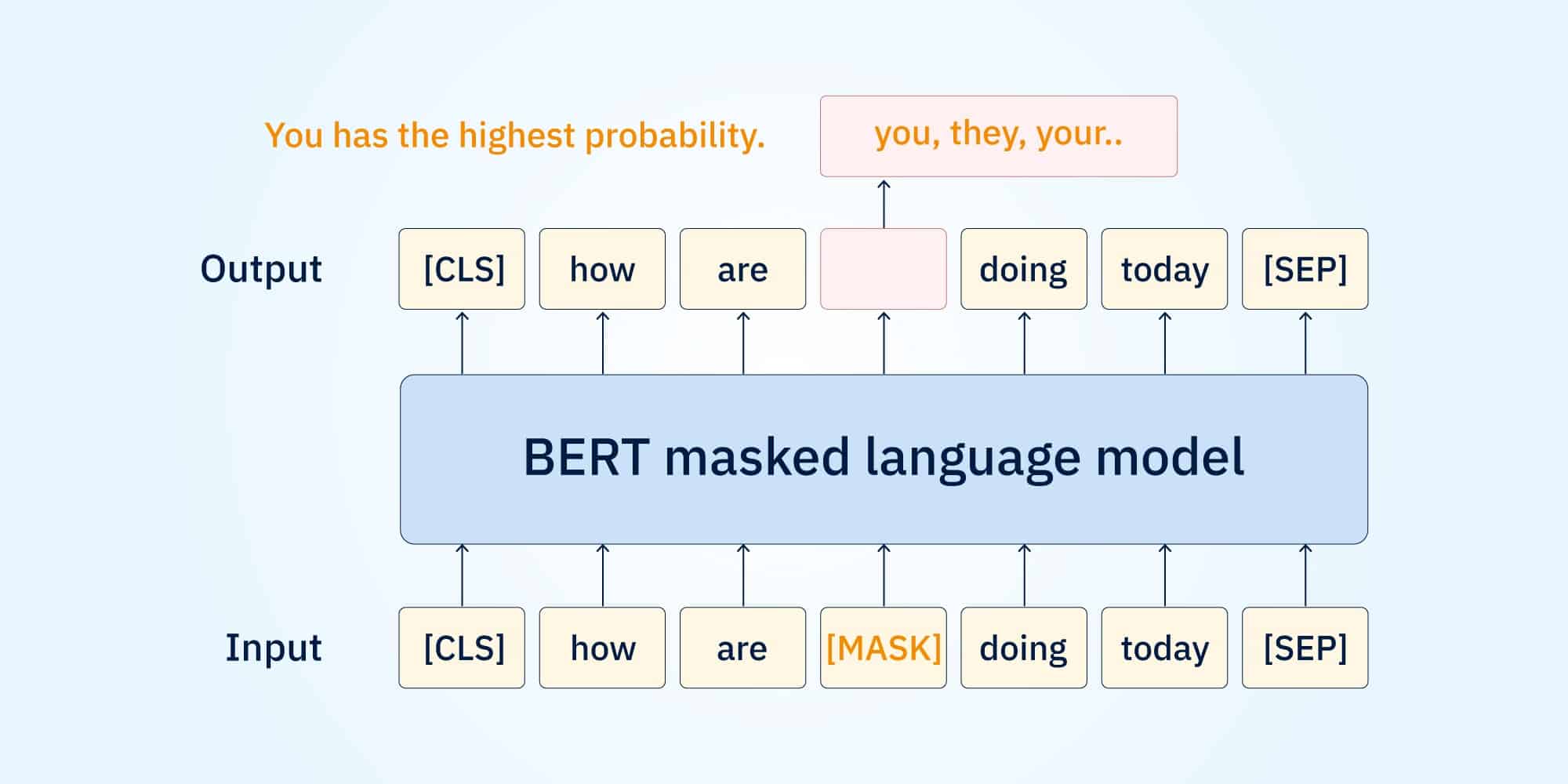
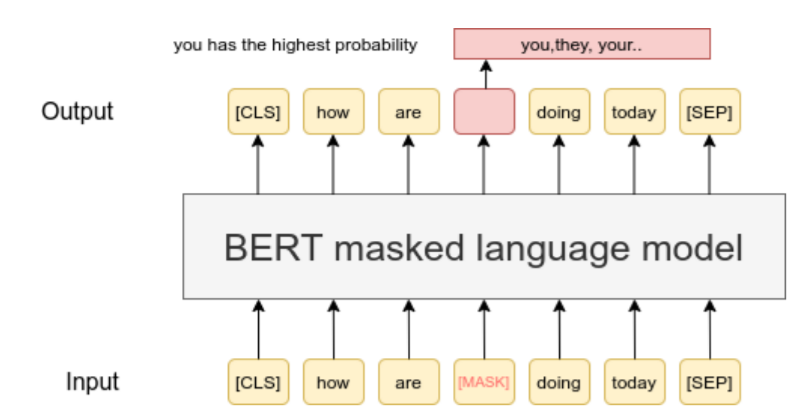
Masked Language Modeling (MLM): Researchers hide about 15% of the words in a sentence and force BERT to guess what they are based on the surrounding context. This forces the model to learn the structural “glue” of language.
-
Next Sentence Prediction (NSP): BERT is shown two sentences and has to decide if the second one actually follows the first in a logical conversation. This helps it understand long-term coherence, not just individual words.
Reality Check: BERT vs. GPT (They Aren’t Competitors)
A common misconception is that the BERT language model was “killed” by GPT-4 or other large language models (LLMs). This is like saying a microscope was killed by a telescope. GPT is an Auto-regressive model meant for generation (predicting the next word). BERT is an Auto-encoding model meant for discrimination and classification. You use GPT to write a letter; you use BERT to ensure your search engine actually finds the right answer among a billion documents.
Why BERT Still Dominates the 2026 Landscape

Even with the rise of massive parameters, BERT remains a favorite for developers and enterprises for three practical reasons:
1. Efficiency and “Small” Data
Training a massive generative model costs millions. Fine-tuning a BERT language model for a specific task—like legal document analysis or medical sentiment detection—is relatively cheap and requires much less data. It is the “workhorse” AI for specialized industries.
2. The Nuance of Search
Every time you type a complex query into a modern search engine, BERT is likely the one doing the heavy lifting. It handles prepositions like “for” and “to” with incredible grace. Before BERT, a search for “2024 traveler to Brazil visa” might have shown results for Brazilian travelers going elsewhere. BERT understands the “to” matters.
3. Sentiment Analysis That Actually Works
Sarcasm is the final boss of AI. Traditional models struggle with “Oh, great, another rainy day.” BERT, by analyzing the “Oh, great” in the context of “rainy day,” is far more likely to flag that as negative sentiment rather than positive.
How to Actually Implement BERT in Your Strategy
If you are a developer or a business strategist, don’t just “buy AI.” Look for specific applications where understanding is more important than talking.
-
Custom Fine-Tuning: Take a pre-trained BERT model and feed it your company’s specific jargon. It will learn your internal “language” in a way a general LLM never could.
-
Named Entity Recognition (NER): Use BERT to automatically scan thousands of emails to extract names, dates, and contract values with surgical precision.
-
Question Answering (QA): Build internal knowledge bases where employees can ask “What is our policy on remote work in France?” and get a direct answer, not just a list of links.
The Future of Bidirectional Context
As we move forward, we are seeing “DistilBERT” and other lighter versions that bring this power to mobile phones and edge devices. The BERT language model proved that you don’t need to be the biggest model in the room to be the smartest. You just need to know how to look at the world from more than one direction.