The Logic of Choice Decoding Machine Learning Algorithms
If you’ve ever tried to teach a toddler that a toaster is hot without them actually touching it, you’ve performed a primitive version of data labeling. You are trying to instill a “rule” based on an observation. Now, imagine doing that a billion times a second with a student that never gets tired, never gets bored, but also possesses zero common sense.
That student is a machine learning algorithm. It is essentially a recipe—a set of mathematical instructions that tells a computer how to find its own way to an answer. Instead of a human programmer writing “If X happens, do Y,” the algorithm looks at a mountain of “X” and figures out that “Y” is the most likely outcome. It’s the difference between giving someone a map and teaching them how to read the stars.
The Puppet Masters Behind the Screen
Every time you scroll through a feed or get a fraud alert from your bank, a specific machine learning algorithm is working in the dark. These aren’t just lines of code; they are different “personalities” of logic designed for different types of chaos.
Linear Regression: The Straight Shooter
Think of this as the most basic, “no-nonsense” algorithm. It’s the one that tries to draw a straight line through a cloud of dots. If you’re trying to predict house prices based on square footage, Linear Regression is your go-to. It assumes the world is predictable and moves in a straight line. It’s often wrong in complex scenarios, but it’s the bedrock of all predictive logic.
Decision Trees: The Flowchart Thinker
This algorithm plays a game of 20 Questions. Is the user over 18? Yes. Do they live in London? No. Have they bought shoes in the last 30 days? Yes. By splitting data into branches, it arrives at a conclusion. It’s highly intuitive—humans love it because we can actually see why it made a choice. However, give it too much data, and it becomes “overfitted,” growing so many branches that it loses sight of the forest for the trees.
Reality Check: The “Magic Box” Myth
There is a dangerous misconception that a machine learning algorithm is an objective truth-teller. We often hear people say, “The algorithm said so,” as if it were a divine decree.
The Reality: An algorithm is a mirror, not a window. It doesn’t see the world as it is; it sees the world as your data depicts it. If your data is biased, the algorithm will be biased with terrifying efficiency. It doesn’t have an “ethical” filter unless you build one. An algorithm isn’t “smart”—it’s just very, very obedient to the patterns it was fed.
Random Forest: Strength in Numbers
If a Decision Tree is one person’s opinion, a Random Forest is a democratic vote. It creates hundreds of different trees and averages their results. This is why your Netflix recommendations don’t just change because you watched one weird documentary at 3 AM. The “Forest” ensures that outliers don’t hijack the logic.
The Secret Sauce: Why Some Algorithms Fail
In my editorial opinion, the tech industry spends way too much time talking about the “sophistication” of an algorithm and not enough time talking about its “diet.”
A mediocre machine learning algorithm with great data will outperform a world-class algorithm with “noisy” or messy data every single time. We are currently obsessed with Neural Networks—the “Deep Learning” stars of the show—but for 80% of business problems, a simple XGBoost or Logistic Regression is faster, cheaper, and more reliable. We often use a chainsaw to cut butter because the chainsaw looks cooler in a press release.
From Theory to Action: Choosing Your Tool
.webp)
How do you actually apply this? It starts by matching the problem to the personality of the machine learning algorithm:
-
Need to classify things? (Spam vs. Not Spam): Use Support Vector Machines (SVM). They are experts at drawing boundaries between different groups.
-
Need to find hidden groups? (Customer Segmentation): Use K-Means Clustering. It doesn’t need labels; it just finds people who “look” like each other in the data.
-
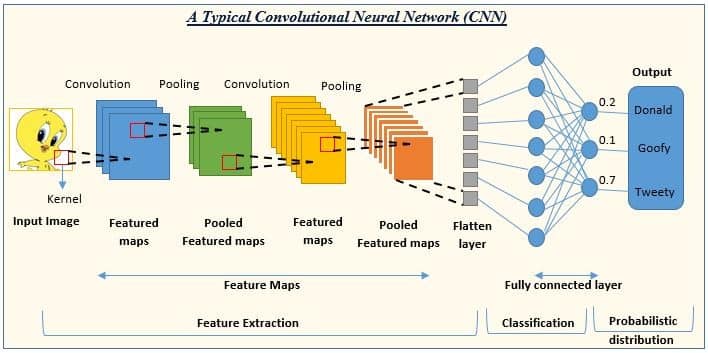
Need to predict the next word? (LLMs): This is where we enter the territory of Transformers and Neural Networks, mimicking the layered firing of human neurons to understand context.
Practical Step: The “Pre-Processing” Ritual
Before you even pick an algorithm, you must “normalize” your data. If one column is “Age” (0–100) and another is “Annual Salary” (0–1,000,000), most algorithms will freak out because the salary numbers are so much bigger. Scaling your data so everything is on a level playing field is the single most important thing you can do for your model’s health.
The Underrated Element: Interpretability vs. Accuracy
We are currently in a “Black Box” crisis. The more powerful a machine learning algorithm becomes (like Deep Learning), the harder it is to explain why it did what it did.
In medicine or law, “Because the AI said so” isn’t a legal defense. This is why “Explainable AI” (XAI) is becoming the next big frontier. Sometimes, it is better to use a slightly less accurate algorithm that you can explain to a judge or a patient than a 99% accurate one that is a complete mystery.
Closing Thoughts: The Algorithm is Your Intern
Think of a machine learning algorithm as a very fast, very literal intern. It will do exactly what you show it, not what you want it to do. As we move further into 2026, the competitive advantage isn’t having the algorithm—everyone has access to the same open-source libraries. The advantage is in the human who knows how to ask the right questions and clean the right data.
Don’t worship the math. Understand the logic, respect the bias, and always keep a human hand on the kill switch.