Regularization Technique Keeping Your AI Grounded in Reality
In 2018, a group of researchers tried to train an AI to distinguish between photos of huskies and wolves. On paper, the model was a genius, hitting nearly 100% accuracy in the lab. But when they took it outside, it failed miserably, labeling a husky on grass as a wolf. Why? The AI hadn’t learned what a wolf looked like; it had simply noticed that all the wolf photos in the training set had snow in the background. It wasn’t “smart”—it was just a world-class cheater that found a shortcut in the data.
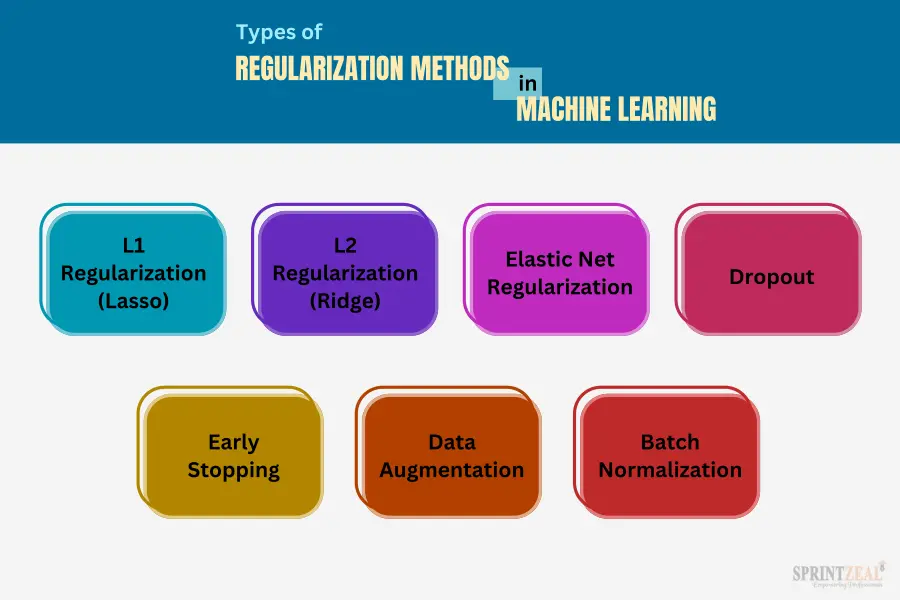
This is the nightmare of overfitting, and it is exactly what a regularization technique is designed to kill. In the simplest terms, regularization is a set of methods used to prevent a machine learning model from becoming too complex or “too obsessed” with the noise in your training data. It forces the model to stay humble and focus on the big picture rather than memorizing every tiny, irrelevant detail like the snow behind a wolf.
The Overfitting Trap: When More is Less
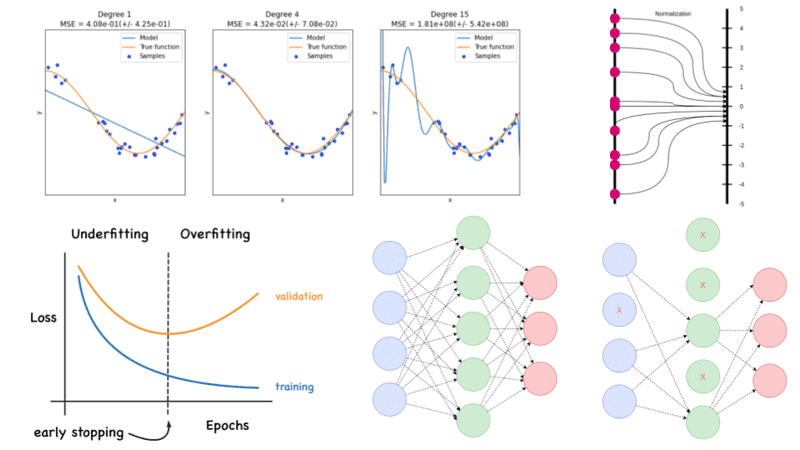
In machine learning, we often think that a lower error rate is always better. But there is a dangerous tipping point. If your model fits your training data too perfectly, it loses its “generalization” power. It becomes like a student who memorizes the exact answers to a practice exam but has no idea how to solve the same problems when the numbers are changed in the real test.
By applying a regularization technique, we deliberately add a “penalty” to the model for being too complex. We are essentially telling the AI: “I want you to be accurate, but I’ll punish you if you try to get there by using overly complicated logic.”
The Heavy Hitters: L1 and L2 Regularization
When you start diving into code, you’ll most likely encounter two legendary brothers in the regularization world: Lasso and Ridge.
1. L1 Regularization (Lasso)
L1 is the “minimalist.” It adds a penalty based on the absolute value of the weights. The fascinating thing about L1 is that it can actually force the weights of less important features to zero.
Editorial Opinion: I like to think of L1 as a brutal editor. If a feature isn’t pulling its weight, L1 deletes it entirely. This is incredibly useful for “Feature Selection,” helping you realize that maybe you don’t need 200 variables to predict house prices; maybe only 5 actually matter.
2. L2 Regularization (Ridge)
L2 is the “diplomat.” Instead of deleting features, it penalizes the square of the weights. This forces the weights to be very small, but rarely zero. It spreads the influence across all features rather than letting one or two “diva” variables dominate the entire model. It’s the go-to regularization technique for when you want to keep all your data but ensure no single part of it becomes a dictator.
Dropout: The “Chaos Monkey” of Neural Networks
If you’re working with Deep Learning, you’ve likely heard of Dropout. This technique is brilliantly simple and a bit chaotic. During training, the system randomly “turns off” a percentage of neurons in each layer.
Imagine a basketball team where, during practice, the coach randomly benches two players every five minutes. The remaining players can’t rely on a single superstar; they all have to learn how to play every position. This makes the team—or in our case, the neural network—incredibly robust and less likely to rely on specific, coincidental patterns in the data.
Reality Check: Regularization Isn’t a Cure for Bad Data
There is a massive misconception that you can fix a garbage dataset by just “cranking up the regularization.” This is false. Regularization is a fine-tuning tool, not a miracle worker. If your data is biased, or if you don’t have enough of it, a regularization technique will only help you create a model that is “consistently wrong” instead of “erratically wrong.” You cannot regularize your way out of poor data collection.
Finding the Sweet Spot: The Bias-Variance Tradeoff
The ultimate goal of using these techniques is to find the “Goldilocks Zone.”
-
High Bias (Underfitting): The model is too simple (like a car that only turns left).
-
High Variance (Overfitting): The model is too sensitive to noise (like a car that swerves for every pebble).
-
The Sweet Spot: A model that ignores the pebbles but follows the curve of the road.
Practical Action: When you see your training loss going down but your validation loss starting to climb back up, that is the “Bat-Signal” for regularization. Stop the training or increase your penalty.
The Forgotten Hero: Early Stopping

Perhaps the most underappreciated regularization technique is “Early Stopping.” You don’t always need complex math. Sometimes, the best way to prevent overfitting is to simply stop the training before the model starts “memorizing.” By monitoring the validation error and cutting the power the moment it stops improving, you save time, electricity, and your model’s integrity.
Conclusion: Complexity is a Liability
In a world obsessed with “Big Data” and “Deep Networks,” it’s easy to think that more complexity equals more intelligence. But in machine learning, complexity is often a liability. A regularization technique is the discipline that keeps our models honest. It’s the voice of reason that tells the AI, “Don’t tell me about the snow; tell me about the wolf.”
By mastering these techniques—whether it’s the surgical precision of L1, the balance of L2, or the healthy chaos of Dropout—you move from being a “model builder” to a “model architect.” You build systems that don’t just look good on your laptop, but actually work when they hit the messy, unpredictable streets of the real world.