The Ghost in the Machine Decoding the Recurrent Neural Network and Its Legacy
Imagine trying to understand a movie by looking at individual, isolated frames without knowing what happened five seconds earlier. You would see a man jumping, but you wouldn’t know if he’s diving into a pool or escaping an explosion.
This was the fundamental limitation of early artificial intelligence. Standard neural networks lived in a perpetual state of amnesia—they processed inputs as independent entities. To bridge this gap, engineers developed the Recurrent Neural Network (RNN). Unlike traditional feed-forward networks, an RNN possesses a “loop” that allows information to persist. It’s the first time we taught a machine that the past actually matters for the present.
A Recurrent Neural Network is designed specifically to handle sequential data. Whether it’s the sequence of words in a sentence, the fluctuations of stock prices over a week, or the rhythmic patterns of a heartbeat, the RNN’s job is to recognize patterns that unfold over time.
Editorial Opinion: While the tech world is currently obsessed with Transformers and LLMs, I believe understanding RNNs is non-negotiable. You cannot truly appreciate how GPT works without understanding the “memory struggle” that RNNs tried to solve first.
How the Feedback Loop Creates “Memory”
In a standard network, data flows in one direction: from input to output. A Recurrent Neural Network breaks this linear path. It takes the output of a specific step and feeds it back into the network as part of the input for the next step.
Think of it as a mental sticky note. As the network reads a sentence word by word, it writes a small summary of what it has seen so far on that note. When it moves to the next word, it reads the note and the new word together. This hidden state is what gives the network its “recurrent” nature. It allows the model to maintain a internal state that represents the context of the entire sequence, making it incredibly powerful for tasks like language translation or speech recognition.
The Reality Check: Why RNNs Often “Forget”

Here is a misconception we need to clear up: just because a Recurrent Neural Network has a loop doesn’t mean it has a perfect memory. In fact, standard RNNs are notoriously bad at remembering things that happened a long time ago.
In technical terms, this is known as the Vanishing Gradient Problem. During the training process, the “signal” used to update the network’s weights becomes smaller and smaller as it travels back through time. By the time it reaches the beginning of a long sentence, the signal is so faint that the network effectively “forgets” the first few words. If you’re trying to predict the end of a paragraph based on a clue in the first sentence, a basic RNN will likely fail.
From Basic RNNs to LSTM and GRU
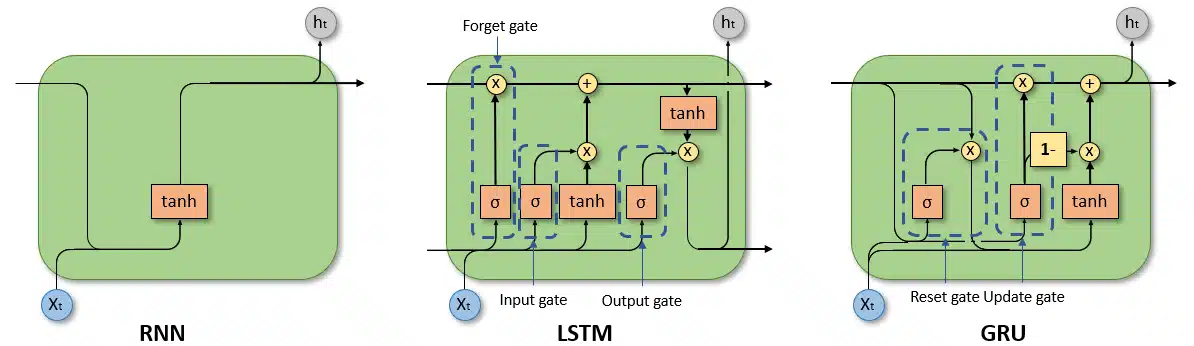
Because of this “forgetfulness,” researchers didn’t stop at basic RNNs. They built more complex versions like Long Short-Term Memory (LSTM) and Gated Recurrent Units (GRU).
-
LSTM: Imagine the sticky note now has a “gatekeeper.” The LSTM architecture uses specialized gates to decide which information is worth keeping, which should be ignored, and when to clear the memory. This solved the vanishing gradient problem and allowed AI to process much longer sequences.
-
GRU: Think of this as the streamlined, faster cousin of the LSTM. It simplifies the gating mechanism, making it computationally cheaper while often achieving similar performance.
Practical Action: When Should You Actually Use an RNN?
In an era dominated by Transformers (the “T” in ChatGPT), you might wonder if the Recurrent Neural Network is obsolete. The answer is: not quite.
While Transformers are better at processing massive amounts of data in parallel, RNNs are still highly efficient for:
-
Real-time Edge Devices: If you are running a small sensor on an IoT device with limited battery, a lightweight RNN can often process sequential data faster and with less power than a massive Transformer model.
-
Small Datasets: Transformers are data-hungry. If you only have a few thousand data points of time-series data, a GRU might actually generalize better than a complex attention-based model.
-
Signal Processing: For simple audio or physiological signals where the sequence is straightforward, the simplicity of an RNN is still a valid architectural choice.
The Legacy of Recurrent Architecture

The evolution of the Recurrent Neural Network changed the trajectory of AI. It moved us away from static “if-this-then-that” logic and into the realm of contextual understanding. It taught us how to model time.
Even as we move toward more advanced architectures that use “attention mechanisms” instead of recurrent loops, the core philosophy remains the same: context is king. The RNN was the pioneer that proved machines could—and should—remember the past to predict the future.