Transfer Learning The Shortcut That Makes Modern AI Possible
If you spend ten years learning how to play the piano, and then decide you want to learn the organ, do you start back at “Do-Re-Mi” like a five-year-old? Of course not. Your brain already understands rhythm, scales, and finger dexterity. You simply “transfer” that existing knowledge to a new instrument. For a long time, computers were too stubborn to do this; if you wanted a machine to recognize a pear after it already knew what an apple was, you had to start its education from a blank slate.
This is the inefficiency that transfer learning solves. In the world of machine learning, it is the practice of taking a model developed for one task and reusing it as the starting point for a model on a second, related task. It is the reason why a small startup with two laptops can now build AI that rivals tech giants—because they aren’t building from zero; they are standing on the shoulders of giants.
The Death of the “Start From Scratch” Era
In the traditional machine learning workflow, you gather a massive dataset, label it, and feed it into a neural network. You wait weeks for the GPU to crunch the numbers. This is fine if you are Google or Meta. But for the rest of us, it’s a barrier to entry that feels like a brick wall.
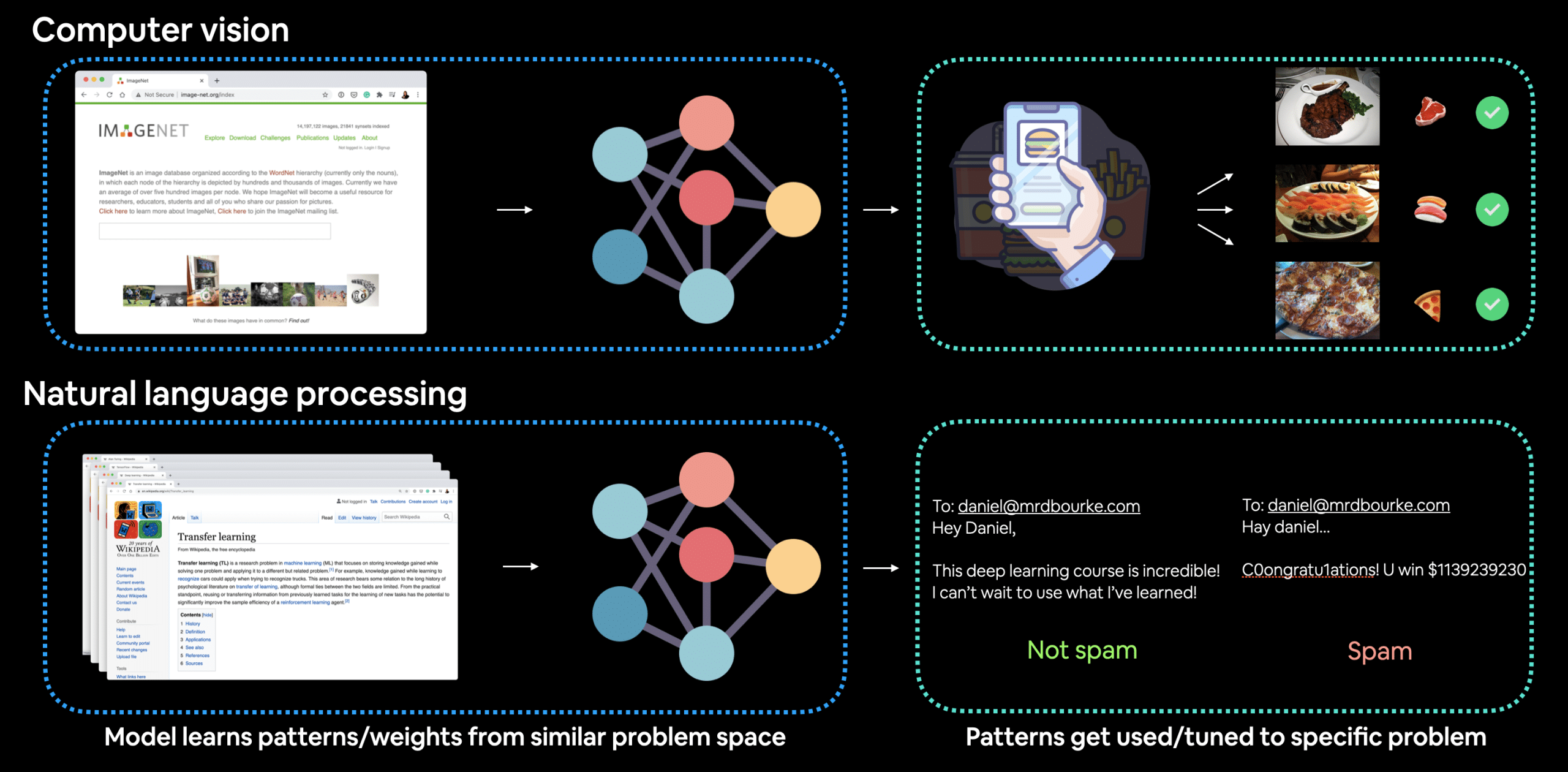
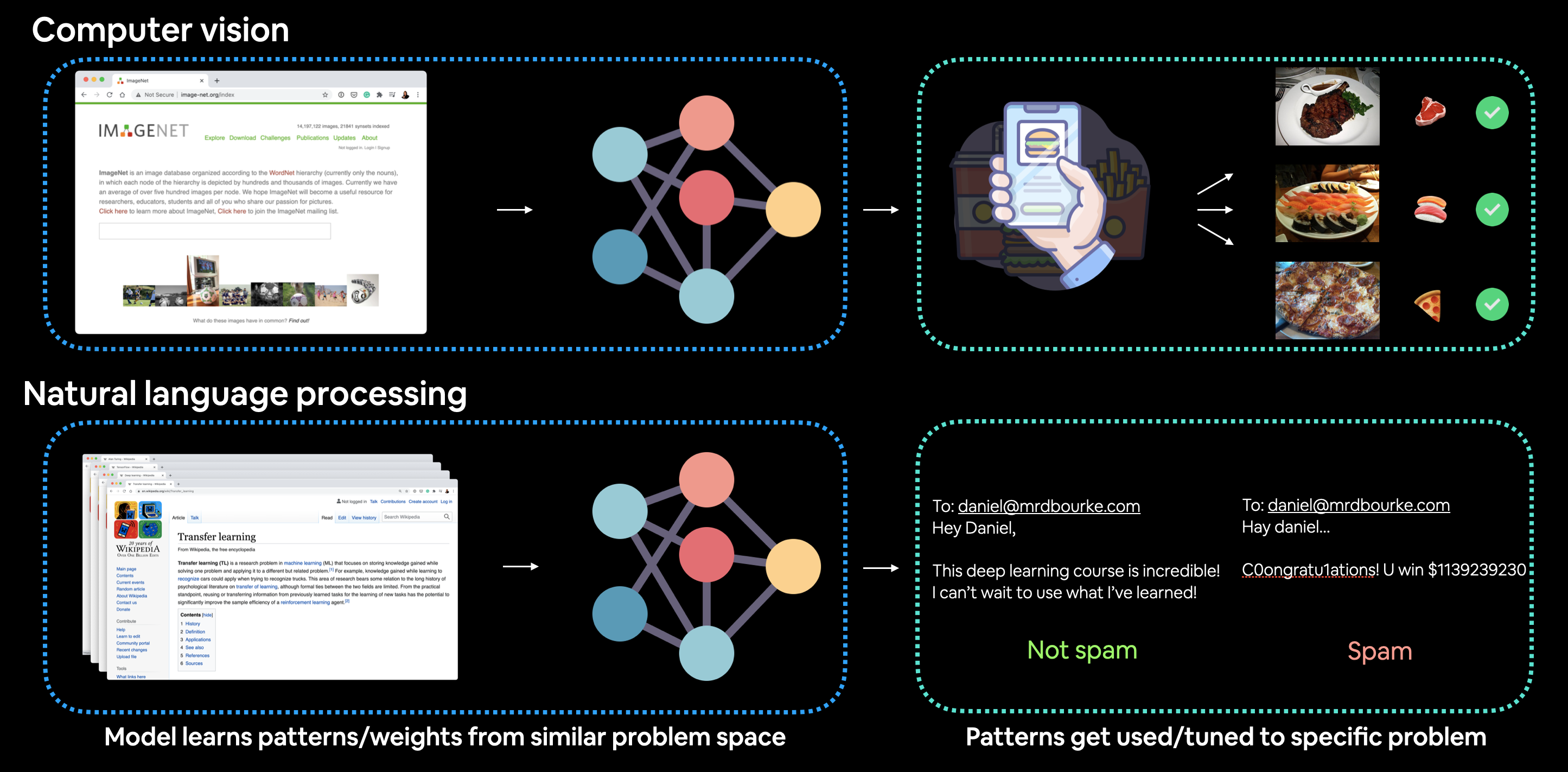
Transfer learning flipped the script. Instead of training a deep neural network (which might have millions of parameters) with random initial weights, we start with weights that have already been “pre-trained” on a massive general dataset, like ImageNet for vision or Wikipedia for text.
Editorial Opinion: Personally, I believe this is the most “human” thing we’ve taught machines to do. It mimics our own cumulative culture. We don’t reinvent the wheel every generation; we read books written by people who already did the hard work. Transfer learning is essentially the “textbook” for AI.
How It Works: The “Feature Extraction” Magic
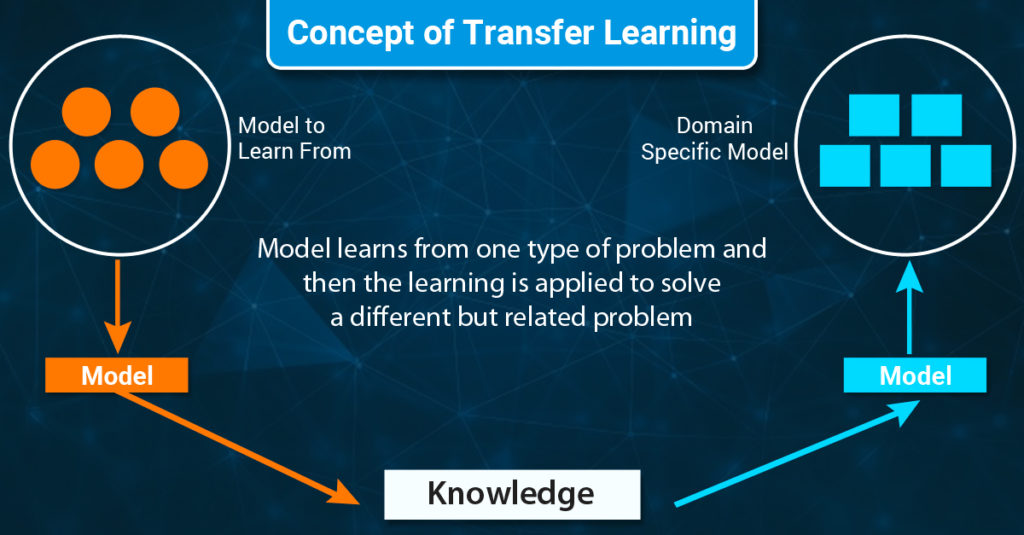
To understand why this works, you have to look at how neural networks “see” or “read.” In the early layers of a model, the AI learns very basic things. If it’s a vision model, the first few layers learn to detect edges and blobs. These “features” are universal. An edge in a picture of a dog looks exactly like an edge in a picture of a satellite view of a forest.
When we use transfer learning, we keep those early, universal layers (the “frozen” layers) and only retrain the final layers (the “head”) to specialize in our specific task.
-
Select a Pre-trained Model: Pick a heavyweight like ResNet (for images) or BERT (for text).
-
Freeze the Base: Keep the knowledge of edges, textures, or grammar intact.
-
Replace the Head: Swap the output layer with one that fits your specific goal (e.g., detecting a specific skin disease vs. general objects).
-
Fine-Tuning: Run a small amount of your own data through the model to polish the results.
Reality Check: It’s Not a Magic Wand
There is a common misconception that transfer learning works for everything. It doesn’t. This is called “Negative Transfer.” If you try to use a model trained on medical X-rays to help you identify different types of luxury handbags, the “knowledge” doesn’t translate well. In fact, the pre-existing weights might actually confuse the model, making it perform worse than if you had started from scratch. Transfer only works when the features are fundamentally related.
Why Every Developer is Obsessed With It
The benefits aren’t just technical; they are economic and environmental.
1. The “Small Data” Solution
Machine learning is notoriously “data-hungry.” Usually, you need 10,000+ images to get something decent. With transfer learning, you can often get world-class results with as few as 100 or 500 images because the model already knows what an “object” looks like. It just needs to learn the “labels.”
2. Saving the Planet (and Your Wallet)
Training a large language model from scratch consumes as much electricity as several homes use in a year. By using pre-trained models, we drastically reduce the carbon footprint of AI development. It turns a “weeks-long” process into something that can be done in an afternoon.
3. Rapid Prototyping
In a business context, speed is everything. Transfer learning allows teams to validate an idea in days. If the model works with transfer learning, it’s worth pursuing. If it doesn’t, you haven’t wasted three months of compute time finding that out.
Practical Steps: How to Start
If you’re looking to implement this, you don’t need to write complex math. Libraries like TensorFlow Hub, PyTorch’s Torchvision, and Hugging Face have made this incredibly accessible.
-
Step A: Identify your domain. Is it NLP? Computer Vision? Audio?
-
Step B: Find a “state-of-the-art” (SOTA) model. For images, look at EfficientNet or ViT. For text, look at RoBERTa or T5.
-
Step C: Use “Data Augmentation.” Since you’re using less data, flip, rotate, or tweak your images to make the model even more robust.
The Future: Transcending Domains
We are now entering the era of “Foundation Models.” These are models so massive and well-trained that they can be transferred to almost anything. We’re seeing “Cross-Modal Transfer,” where knowledge from text-based models is helping improve computer vision models. The walls between different types of AI are melting away.
Conclusion: The Era of Efficient Intelligence
Transfer learning is the Great Equalizer. It has moved AI out of the ivory towers of elite research labs and into the hands of every developer with a creative idea. By focusing on reusing intelligence rather than recreating it, we are making AI faster, greener, and more accessible.
The next time you use an app that magically identifies a plant or translates your voice in real-time, remember: that AI didn’t learn everything on its own. It’s likely standing on the shoulders of a giant model that came before it.