Beyond the Screen Why Gesture Recognition is the Final Frontier of Human-Computer Interaction
Imagine walking into a room and, with a simple flick of your wrist, the lights dim, your favorite playlist begins to hum, and the thermostat adjusts to your preferred chill. No buttons, no fingerprints on glass, no shouting at a voice assistant that can’t hear you over the AC.
This isn’t a scene from a 2040 sci-fi flick. It is the practical reality of gesture recognition—a technology that is quietly moving from the “gimmick” phase into a functional necessity. While we’ve spent the last decade glued to our touchscreens, we are finally realizing that touching things is, quite frankly, a bit primitive.
What is Gesture Recognition, Really?
At its core, gesture recognition is a sub-discipline of computer science that interprets human movements via mathematical algorithms. It’s the bridge between our physical body language and digital execution.
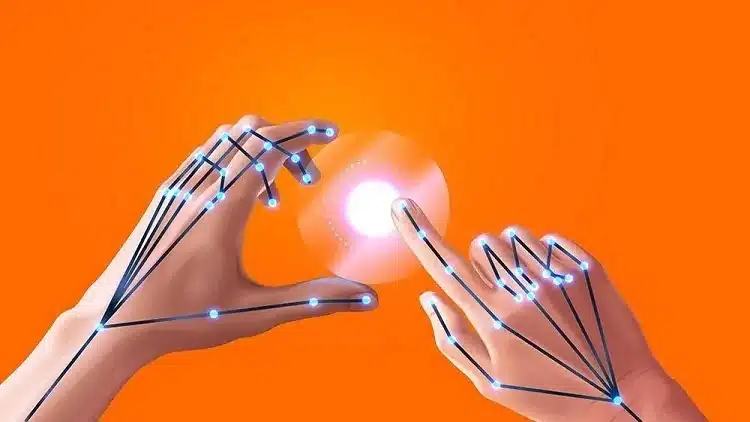
Unlike a mouse or a keyboard, which requires a physical intermediary, gesture recognition uses sensors—ranging from standard RGB cameras to advanced LiDAR and infrared—to track the coordinates of your hands, face, or body. These coordinates are then fed into a computer vision model that says, “Aha! That circular motion means ‘turn up the volume’.”
The Tech Stack Behind the Motion

-
Computer Vision: The “eyes” that analyze pixel changes in real-time.
-
Depth-Sensing (ToF/LiDAR): Sensors that calculate how far your hand is from the device, creating a 3D map of your movement.
-
Machine Learning: The “brain” that learns to distinguish between you waving hello and you just swatting a fly away.
Reality Check: The “Minority Report” Fallacy
We need to address the elephant in the room: Tom Cruise in Minority Report. Pop culture has conditioned us to think that gesture recognition means standing in front of a giant glass wall, waving our arms like an aggressive conductor.
The Reality: If you actually did that for an eight-hour workday, you’d suffer from what researchers call “Gorilla Arm Syndrome.” Your shoulders would be on fire within twenty minutes. The future of this tech isn’t in big, sweeping movements; it’s in micro-gestures. The most successful implementations today are small, subtle finger movements that you can do while your hand is resting comfortably on your lap.
Why This Matters Now: Beyond the Cool Factor
Why bother with gestures when touchscreens work fine? Because in many high-stakes environments, touch is actually a liability.
1. The Sterile Operating Room
In a surgical suite, hygiene is everything. A surgeon needs to check a patient’s X-ray or scroll through a digital chart mid-procedure. Touching a mouse or a screen means re-scrubbing. With gesture recognition, they can “swipe” through medical records in the air, maintaining total sterility while accessing life-saving data.
2. Automotive Safety: Eyes on the Road
Modern cars are becoming iPads on wheels, which is a massive safety hazard. Fumbling for a tiny “Mute” button on a screen while driving at 60 mph is dangerous. Integrating gesture controls allows drivers to change tracks or answer calls with a simple hand wave, keeping their eyes exactly where they belong: on the road.
3. Breaking Barriers in Accessibility
For the millions of people worldwide who use sign language, gesture recognition is a game-changer. AI models are now being trained to translate sign language into text or speech in real-time. This isn’t just about “controlling a TV”; it’s about giving a voice to those who have been digitally marginalized.
The Hidden Challenges: Privacy and “Ghost” Gestures
Every leap in tech has its friction. For gesture recognition, the primary hurdle is precision.
We’ve all experienced a “ghost gesture”—where your TV suddenly changes the channel because you reached for a slice of pizza. Improving the signal-to-noise ratio in crowded or dimly lit environments remains a challenge.
Furthermore, there is the Privacy Paradox. For a system to recognize your gestures, a camera or sensor has to be “always on” and watching you. As we integrate these sensors into our homes, the tech industry must be transparent about whether that data stays on the local device or is sent to the cloud.
Practical Steps for Implementation

If you’re a developer or a business owner looking to dive into this space, don’t start from scratch.
-
Leverage Existing Frameworks: Use Google’s MediaPipe or OpenCV. These libraries have pre-trained models for hand-tracking that save months of development time.
-
Prioritize Haptic or Visual Feedback: Since there’s no physical button to press, the user needs to see or hear that their gesture was recognized. Without feedback, the experience feels “broken.”
-
Keep it Natural: Don’t invent a new language. A swipe left should mean “back” or “next,” mirroring the mental models users already have from their phones.
Conclusion: A Touchless Tomorrow
The journey of gesture recognition is a move toward a more “human” interface. We were born to move, to point, and to signal. We weren’t born to type on plastic keys. As sensors get smaller and AI gets smarter, the screen will stop being a barrier and start being a transparent window to our intentions.
The most sophisticated technology is the one you don’t even realize you’re using. And soon, a simple nod or a flick of a finger will be all the “code” you ever need to write.